Buy best wall mounted makeup vanity mirror For Sale: What Buyers Should Check Before Ordering
The primary trade-off is mirror glass weight versus wall load rating. A 5 mm copper-free silvered glass panel resists edge corrosion in humid bathrooms but adds dead load to the anchor; a thinner 3 mm panel cuts freight cost and eases installation but shows more bowing over a 600 mm span. Buyers should fix the magnification and glass thickness in the drawing before sampling, because changing either after tooling requires new backing adhesive and a fresh wall-load calculation.
How It Performs in Use
A wall mounted makeup vanity mirror must hold a flat, distortion-free image at the user's eye level while resisting steam and condensation. The glass sits in a metal frame fixed to the wall with two or four anchors, so any twist in the frame transfers directly to the silvered layer. If the frame flexes more than 1 mm across a 400 mm width, the reflection develops a visible wave that fails makeup application checks.
Consistency is set at the forming stage. The frame is roll-formed or stamped from sheet metal, then powder-coated or anodised before the mirror is bonded. A poorly deburred edge chips the glass edge during assembly, and edge chips turn into cracks under temperature cycling. Buyers should specify edge polish and a tolerance of ±0.5 mm on frame squareness.
The build method decides how the mirror survives daily use. A fixed plate is simplest and carries the most weight, but an extendable arm adds pivot points that loosen after repeated extension. Humidity enters through the mounting holes if the back plate is not sealed, causing the silver backing to delaminate from the glass within months. The acceptance test is a 48-hour humidity chamber cycle followed by a reflectivity check at the centre and edges.
Materials and Construction Trade-offs
Frame material sets the weight ceiling and corrosion path. Aluminium extrusions save roughly 40 percent of the dead load compared with cold-rolled steel, but steel tolerates higher torque on wall anchors without thread stripping. Brass offers the best resistance to bathroom salts and cleaning agents, yet it costs two to three times more than aluminium and shows surface patina unless lacquered.
Glass selection determines optical clarity and edge strength. Standard float glass with a copper-backed silver coating is the cheapest route, but copper migrates to the edge in humid rooms and produces black spot corrosion within a year. Copper-free silvering adds cost per square metre but keeps the edge clean after repeated condensation cycles. Low-iron glass removes the green cast that distorts skin tones under warm vanity lighting.
Mounting hardware is the failure point most buyers overlook. A wall anchor rated for 15 kg in concrete may hold only 6 kg in plasterboard, and the mirror's centre of gravity shifts when an extendable arm is fully drawn out. Specify the wall substrate in the purchase order and match the anchor expansion sleeve to that substrate before the first sample ships.
Measured Performance in Real Use
Performance is judged on dimensional stability under humidity, load capacity at the anchor, and optical distortion across the face. A mirror that passes a 72-hour salt spray test on the frame but fails at the mounting hole is still a field failure. Buyers should require a written tolerance for glass flatness and a maximum deflection figure before approving the pre-production sample.
| Parameter | Fixed Plate 400 mm | Extendable Arm 200 mm reach |
|---|---|---|
| Glass thickness | 4 mm or 5 mm | 4 mm |
| Frame material | Aluminium or steel | Steel with brass pivots |
| Mounting load rating | Up to 12 kg per anchor pair | Up to 8 kg fully extended |
| Net weight | 1.8–2.6 kg | 2.4–3.4 kg |
| Maximum edge deflection | Under 0.5 mm at 400 mm span | Under 0.8 mm at full extension |
These figures assume masonry or concrete walls. Plasterboard installations reduce the rating by roughly half unless a backing board is installed. The buyer's specification should state the substrate and the expected load, including any items placed on an attached shelf.
Option Comparison by Usage Level
Low-Use Installation
Guest bathrooms or showroom displays where the mirror is adjusted rarely. A 4 mm float glass plate in an aluminium frame meets the optical requirement at the lowest weight and freight cost. Standard silver backing is acceptable if the room stays below 70 percent relative humidity.
High-Use Installation
Hotel bathrooms or professional makeup stations with daily adjustment and steam exposure. Copper-free 5 mm glass in a steel frame with sealed mounting holes resists edge corrosion and frame twist. Specify an extendable arm only if the pivot torque is tested to 500 cycles.
The specification must be locked before tooling. Drawings, glass thickness, backing type, and anchor selection are agreed on the sample approval form. Any change to magnification or frame depth after the first trial run requires new tooling and a fresh lead-time quote.
Capacity, Tooling and Scheduling
Tooling for the frame is a single-stage stamping or extrusion die, while the mirror cutting and silvering run on a separate line. Lead time depends on whether the buyer accepts stock glass sizes or requests a custom cut. Custom sizes add five to ten working days for die preparation and edge-polish setup.
Sample approval follows a fixed sequence: technical drawing sign-off, glass and frame sample, then a pre-production run of ten to twenty units. The buyer confirms flatness, anchor pull-out resistance, and silver adhesion on the sample batch before mass production begins. Artwork for any frame logo or back plate printing is approved at the same stage to avoid rework.
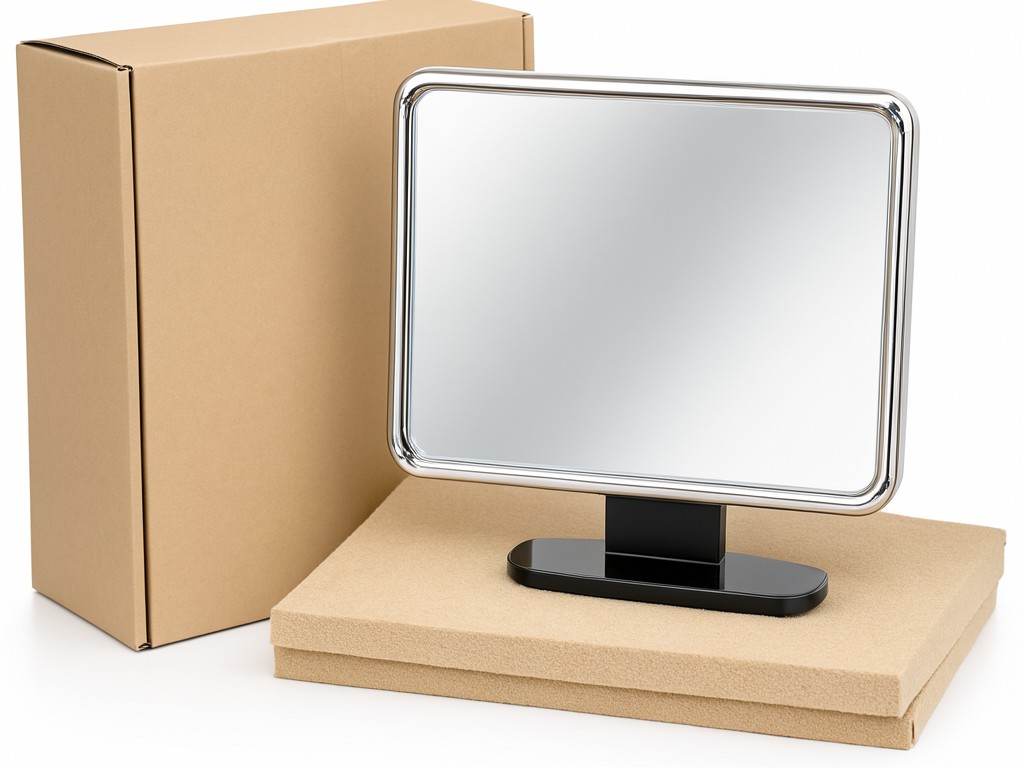
Monthly capacity is typically 5,000 to 8,000 units per frame variant, subject to mirror glass availability. Orders above 1,000 units should be split into two production slots to keep the silvering line balanced. Packaging is export-grade foam and cardboard with corner protection, because glass edge damage in transit is the most common claim reason.
Request a specification review before placing the purchase order. We will verify wall-load ratings, glass thickness, and backing compatibility against your substrate and usage cycle.
Start specification review