Specifying wholesale wall mounted bathroom vanity mirror Company for Wholesale and OEM Orders
Selection trade-off: conventional silver mirror versus copper-free silver mirror.
Conventional silvered glass carries a copper protective layer. It costs less per square metre but develops black edge and silver creep within 12-24 months in a bathroom condensation cycle. Copper-free silver backing replaces that layer with an organic seal, adding roughly 8-12% to the glass cost and extending the corrosion-free service window to 5-7 years under daily humidity exposure. For a private-label bathroom range, the copper-free option is the default unless the buyer specifies a price-point build for dry powder rooms.
Where This Product Beats Standard Alternatives
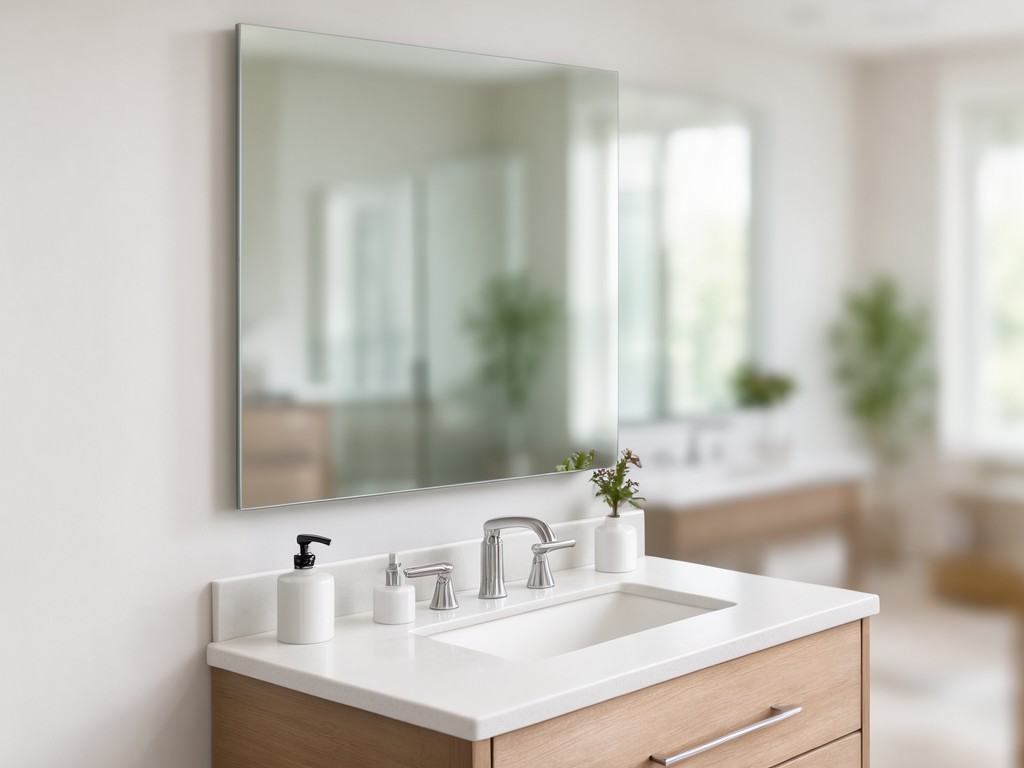
Frameless mirrors shipped without safety backing film are the most common failure source in wholesale bathroom programs. The silver layer separates from the glass at the edge, moisture wicks behind the coating, and the mirror arrives with black spidering already visible at installation. Wall-mounted vanity mirrors also fail at the bracket: thin stamped steel cleats pull out of drywall under a 5 kg load, and MDF backings swell in steam, pushing the glass off its adhesive bed.
A copper-free silvered float-glass mirror, edge-polished and laminated with a peel-resistant safety film, removes the corrosion path at the source. The backing film holds the silver coat if the glass chips, and a 5 mm glass substrate keeps the image plane flat across a 900 mm width without the waviness that thin 3 mm import glass develops after six months on the wall.
- Silver creep and black edge appear first at unpolished cut edges, which is why every edge receives a flat polish or bevel before silvering.
- Safety backing film is specified by retention force, not thickness alone; the film must hold a fractured pane without delaminating at 60 °C.
- Mounting hardware is rated to the mirror weight plus a 2× safety factor; a 600 mm vanity mirror typically weighs 11-14 kg depending on glass thickness.
Size, Weight and Specification Range
The build method decides the tolerance band. Float glass is cut on a CNC bridge, edged on a straight-line edger, then silvered on a horizontal coating line. Widths above 1 000 mm require 5 mm glass to hold flatness under the mirror’s own weight once wall-mounted; 4 mm is reserved for 600 mm and smaller powder-room units.
| Parameter | Standard Range | OEM Option |
|---|---|---|
| Glass thickness | 4 mm, 5 mm, 6 mm | 6 mm for oversize vanity panels |
| Width | 400–1 200 mm | up to 1 500 mm with centre bracket |
| Height | 500–900 mm | Floor-length vanity mirrors to 1 800 mm |
| Backing | Copper-free silver + safety film | MDF back panel with concealed cleat |
| Mounting load rating | 15 kg per pair of brackets | 25 kg with French cleat |
OEM and ODM Programme Structure
First-article tooling determines the unit economics. A new frame profile or custom bevel angle requires a die and a first-article approval run of 50–100 pieces; the tooling cost is amortised over the order volume, so a 500-piece programme carries a higher per-unit setup recovery than a 5 000-piece release. LED-integrated vanity mirrors add a driver and defogger layer, which shifts the bill of materials toward components rather than glass processing, and the lead time moves from glass-line availability to electronic component procurement.
ODM orders start from our standard size and backing configuration, with changes limited to edge polish type, bracket pattern, and private-label packaging artwork. OEM orders open the full specification: glass thickness, silver chemistry, frame material, bracket layout, and optional IP44-rated lighting. Volume breaks typically land at 500, 1 000 and 2 500 pieces per SKU, with lead time compressing from four weeks at pilot volume to two weeks once the silvering line is scheduled for a continuous run.
How Consistency Is Held Across Batches
Consistency is set at the forming stage. Silver thickness variation of even 0.5 µm between batches shows up as tint shift under bathroom LED lighting, so the silvering line is sampled every two hours during a run and the coating weight is recorded against the batch number. Edge polish pressure is checked per shift because a heavy cut removes glass and changes the reflected image at the bevel.
Each batch receives a dimensional check on width, height and diagonal squareness, plus a cross-cut tape test on the backing film adhesion. Mirrors that fail the silver adhesion test are pulled before packing, and the batch number is stamped on the packaging so a retail buyer can trace a complaint back to the coating date and silver bath used.
Export Packaging and Handling Protection
Mirror damage concentrates at the corners and edges during LTL and ocean freight. A single corner strike can chip the glass and expose the silver coating to humidity, starting the black-edge failure the buyer sees six months after installation. Standard export packaging uses edge foam, corner protectors, a double-wall carton, and a moisture barrier sheet for the container leg.
Oversize vanity mirrors above 1 000 mm move in wooden crates with interlayer paper and individual sleeve wrapping. The crate is rated for double stacking, and the mirror is secured with corner blocks so it cannot shift during transit. Packaging specification is part of the sample approval, and the buyer signs off on the carton drop orientation before the first production release.
Questions Buyers Ask Before Ordering
How long is the lead time? A repeat ODM order of 1 000 pieces in a standard 500 × 700 mm size usually ships in two to three weeks after sample approval; a new OEM frame adds four to six weeks for tooling and first-article sign-off.
Can the mirror be made copper-free? Yes, copper-free silver backing is the default for bathroom vanity specifications and adds roughly 8–12% to glass cost versus conventional silver with a copper protective layer.
What mounting hardware is included? Brackets are rated to the mirror weight plus a 2× safety factor; a 600 mm vanity mirror typically weighs 11–14 kg depending on glass thickness, and the hardware is matched to that load.
Is sample approval required before production? Yes, the first article is checked for edge polish, silver adhesion and diagonal squareness, and the buyer signs off on dimensions and packaging before the batch is released.
Request a Specification Review
Send your target glass thickness, backing type and annual volume for a unit-cost model and lead-time quote. Tooling charges are quoted separately and amortised over the first release.