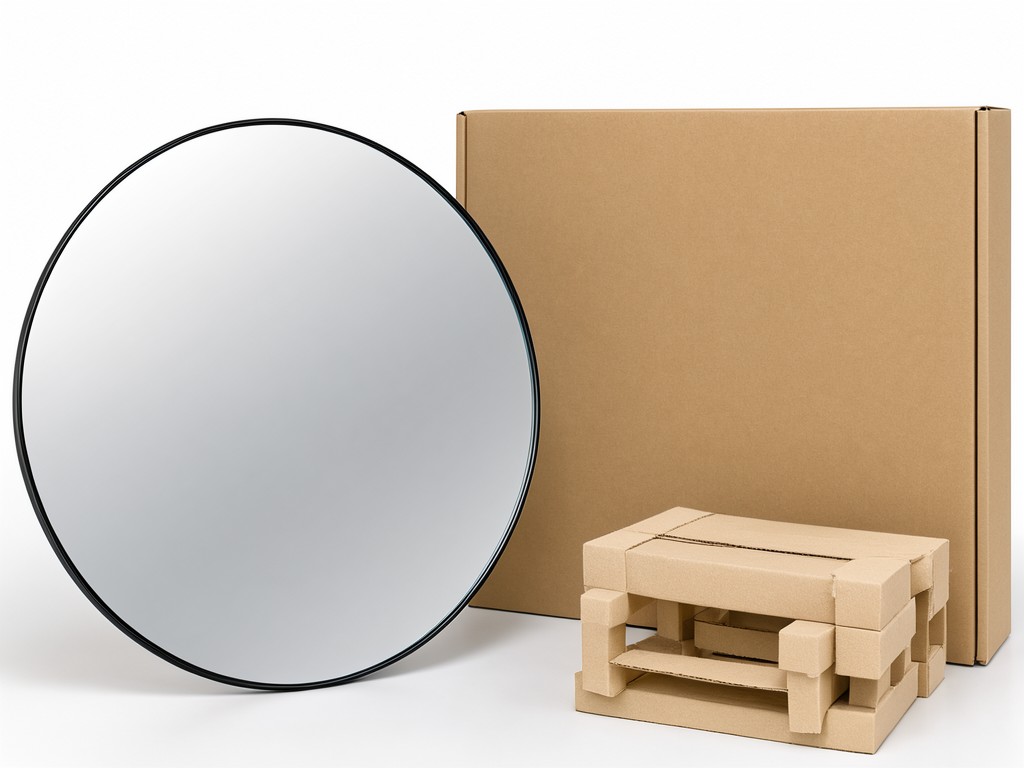
Specifying wholesale round framed bathroom vanity mirrors supplier for Wholesale and OEM Orders
During a private-label launch with a fixed ship date, the first batch of round framed bathroom vanity mirrors often arrives with black edges creeping inward from the frame joint or silver coating lifting where the glass meets the backing board. A 4 mm float glass sheet with conventional copper-bearing silvering fails in sustained bathroom humidity because the coating delaminates at the edge within months, and a 2 mm frame miter gap lets moisture wick straight into the rebate. The decision rule is to specify copper-free mirror glass, a closed-cell gasket or sealant bead at the frame rebate, and a backing board that does not swell, then hold each production lot to a ±1 mm diameter tolerance and a cross-cut adhesion pass.
Moving from sample orders to container loads changes the inspection math because a perfect hand-checked sample says nothing about batch drift in frame finish or glass flatness across fifty cartons. A frame that looks straight at the sample stage can develop a 0.5 mm twist after powder coating, and a mirror blank with 0.3 mm bow will not sit flush against a tiled wall, creating stress points at the mounting clips. The buyer should require a first-article inspection for diameter, squareness, and coating adhesion, then set a lot-level acceptance limit of 0.2 mm flatness deviation over a 600 mm span.
What This Product Is and Where It Fits
A round framed bathroom vanity mirror is a glass mirror blank edged and polished to a circular diameter, bonded into a metal or wood frame, and sealed against a backing board for wall mounting. It differs from a frameless mirror in that the frame carries the mounting load and protects the glass edge from impact during installation and daily cleaning.
Working principle is straightforward: a reflective metal layer deposited on the back of float glass forms the image plane, while the frame and backing board provide mechanical stiffness and a moisture barrier between the silver layer and the bathroom wall. The weak point is always the edge seal, because water vapour that reaches the silver layer converts to black spots and delamination that no amount of frame polishing can hide.
Typical buyers include hospitality fit-out contractors, multi-family developers, and club or academy purchasing managers fitting gym vanity areas, where each mirror must survive daily wiping with cloth-wrapped cleaning bottles and occasional impact from towels or toiletry kits. The product is chosen over frameless stock when the retailer wants a finished look that hides wall fixings and when the frame colour must match a bathroom cabinet range. Bulk orders are usually packed six to twelve per carton with corner protectors and face film.
What Actually Determines Performance
Performance is judged on glass flatness, frame miter gap, coating adhesion, and corrosion resistance at the frame joint, not on how the mirror looks under showroom lighting. A 5 mm glass blank holds flatness better than 4 mm but adds roughly 12 kg per square metre, which changes the wall anchor specification and the carton weight limit for parcel carriers. The standard failure mode is black edge: moisture penetrates the frame rebate, attacks the silver layer, and the defect spreads under the coating until the mirror is rejected at retail acceptance.
- Glass thickness of 4 mm to 6 mm sets deflection under its own weight and the load rating of the wall anchor.
- Frame miter gap below 0.3 mm slows moisture wicking into the rebate.
- Copper-free silvering resists black edge in humidity chambers longer than conventional copper-bearing coatings.
- Backing board moisture swelling creates pressure on the silver layer and causes edge delamination.
Inspection at the factory uses a straightedge and feeler gauge for flatness, a cross-cut tape test for coating adhesion, and a salt-spray or humidity chamber for frame corrosion. Results are recorded per batch so a repeat order can be traced to a specific production run.
Materials and Construction Trade-offs
Frame material changes the total cost of ownership more than the glass choice. Aluminium extrusions powder-coated in satin or matte black resist corrosion at the miter joint but soften at the fixing point if the wall screw is over-torqued, while stainless steel frames carry higher tooling cost and weight but do not show rust creep at a drilled hole. MDF backing is cheap and easy to print with a brand label, yet it swells in a steamy bathroom and pushes against the mirror edge; plastic or marine-grade ply backing costs more per sheet but keeps the seal intact.
Glass thickness trades weight against edge strength. Four millimetre float glass keeps a 600 mm round mirror under 8 kg, which suits adhesive mounting on drywall, but a 6 mm blank adds roughly 40 percent more mass and requires a mechanical anchor rated for the full panel weight. The coating must be copper-free silver with a protective paint layer, because conventional silvering shows corrosion at the edge within a few months of bathroom exposure.
Construction Method and Its Effect on Consistency
The manufacturing sequence is glass cutting, edge grinding and polishing, silver deposition, paint backing, frame miter cutting, adhesive bonding, curing, and final packing. A miter saw with worn blades produces an open joint at the frame seam, and adhesive that skins before the frame is clamped leaves a gap that water vapour uses as a path to the silver layer. Consistency depends on curing time and clamp pressure, not on the appearance of the first sample.
Batch drift appears when the cutting table is not recalibrated between production runs, so one container has mirrors that sit flush and the next has a 1 mm bow that prevents wall contact. The factory should check diameter and flatness on every tenth unit, record the frame finish batch number, and reject any lot where the cross-cut adhesion test fails at more than one location per panel.
Where This Product Beats Standard Alternatives
A framed round mirror protects the glass edge, which is the most common damage point during container unloading and site handling. Frameless stock chips at the perimeter and exposes the silver layer directly to wall moisture, while a properly sealed frame keeps the reflective coating away from both impact and vapour. The trade-off is weight and frame finish durability: a powder-coated aluminium frame adds cost but removes the need for edge-sealing tape on site.
Specification rule: copper-free or conventional
If the installation is a bathroom or shower room with daily condensation, copper-free silvering is the only defensible choice because conventional coating blackens at the edge under humidity. For a dry powder room or decorative hallway mirror, conventional silvering lowers the unit price but shortens service life.
Size, Weight and Specification Range
Round vanity mirrors are typically ordered from 450 mm to 900 mm diameter in 50 mm increments, with 4 mm, 5 mm, and 6 mm glass options and frame profiles from 15 mm to 30 mm width. A 600 mm diameter, 4 mm glass, aluminium frame unit weighs approximately 7 kg including backing and mounting hardware, while the same size in 6 mm glass approaches 10 kg. Packaging must protect the frame corner and the glass face, because a single impact point on the rim can crack the glass blank across the full diameter.
| Customization Option | Available Range | Unit Cost Impact | Service Life Impact |
|---|---|---|---|
| Glass thickness | 4 mm / 5 mm / 6 mm float glass | +0% / +18% / +38% vs 4 mm baseline | Thicker glass resists edge chip and deflection |
| Frame material | Aluminium alloy / stainless steel / wood composite | Baseline / +25% / -10% | Stainless steel best for humidity; wood swells if unsealed |
| Frame finish | Powder coat / anodized / paint | Baseline / +8% / -5% | Powder coat resists cleaning chemicals best |
| Mirror coating | Conventional silver / copper-free silver | Baseline / +12% | Copper-free prevents black edge in bathrooms |
| Backing board | MDF / moisture-resistant MDF / plastic | Baseline / +6% / +15% | Plastic backing eliminates swell pressure on seal |
| Diameter | 450 mm – 900 mm | Scales with glass area | Larger panels need heavier wall anchors |
| Mounting hardware | Adhesive strips / mirror clips / keyhole slots | Baseline / +3% / +3% | Mechanical clips suit heavier 6 mm panels |
Working as a Production Partner, Not a Catalogue Supplier
When a brand extends an existing range, the supplier must match the previous batch's frame colour and glass thickness within visible tolerance, or the retail buyer receives complaints about mismatched sets. OEM work requires sample approval of the frame finish and mirror edge before tooling is released, then batch traceability so a warranty claim can be tied to a production date and coating batch. The total cost of ownership includes returns processing and replacement freight, which often exceeds the unit price saving from a lower-specification mirror.
Private-label buyers need artwork files for the backing board label, carton marking, and any frame logo engraving, with a lead-time trade-off between custom packaging and standard export cartons. A tooling review before the first production run confirms the frame die, the adhesive cure cycle, and the drop-test packaging configuration, reducing the chance that a container arrives with cracked rims or delaminated backing. Request OEM sample approval
Care, Storage and Service Life
Storage should be flat, dry, and separated by cardboard or foam, because leaning round mirrors against a wall creates edge pressure that cracks the glass over time. Cleaning with ammonia-based or abrasive cleaners attacks the frame finish and can seep into the rebate, so a damp microfibre cloth and dry wipe is the only approved method. Service life is set by the edge seal: if the sealant bead remains intact and the backing board does not swell, the mirror lasts until the frame finish wears or the mounting hardware fails.
Request a tooling review
Send your existing sample or drawing for a frame and coating review before the next production run. We will check diameter tolerance, glass thickness, and sealant specification against your return-rate target.
Start tooling review






