Wholesale black framed bathroom vanity mirror Company: Specification, Ordering and Quality Notes
A black framed vanity mirror is specified by glass thickness, frame projection, and silvering method long before the finish colour is confirmed. Bulk buyers matching a private-label specification usually inherit an existing frame tooling and adjust branding, packaging, and label language rather than redesigning the product. The sections below set out the performance limits, batch controls, and ordering mechanics that determine whether a reorder arrives looking like the approved sample.
What This Product Is and Where It Fits
In a hotel fit-out or a multi-unit residential block, the vanity mirror is checked against the approved sample on first delivery, and the most common field failure is black edge creep along the silver backing after a season of steam and cleaner exposure.
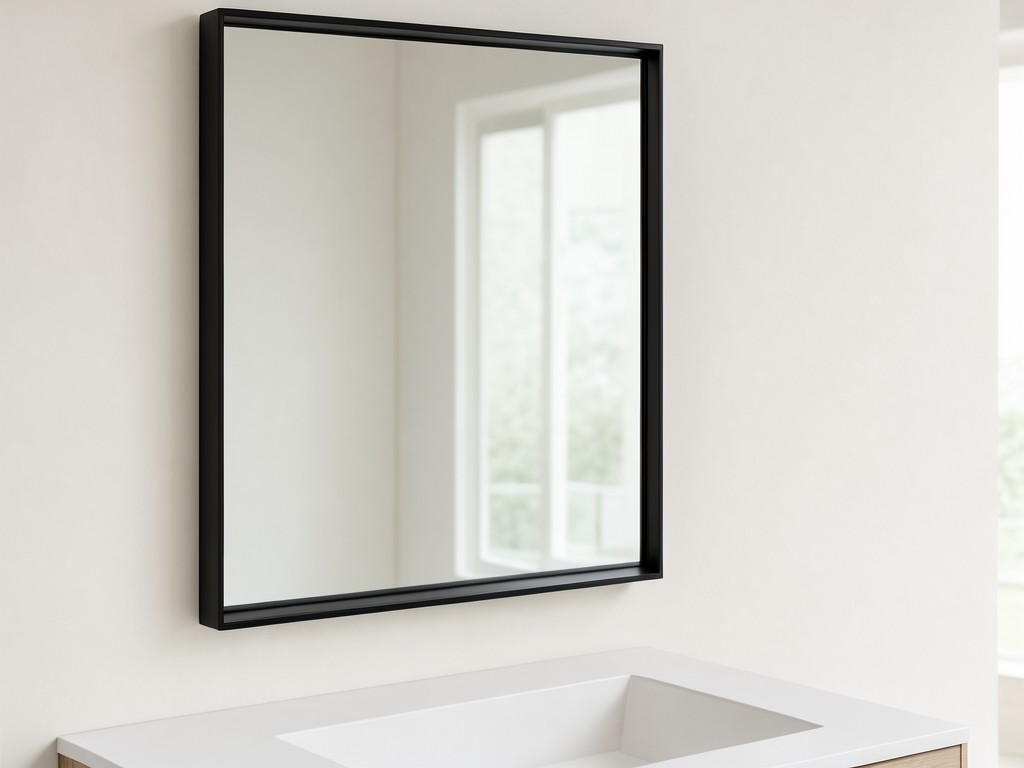
The product is a wall-mounted bathroom mirror with a black frame, typically 4 mm or 5 mm float glass, silvered on the back and sealed at the edge. Frame materials run from extruded aluminium with powder coat to MDF or wood with wet paint, and the overall size usually falls between 500 mm and 1000 mm wide by 600 mm to 900 mm high. Mounting uses a cleat, keyhole slots, or a Z-bar rated to the mirror weight plus a safety factor.
Wholesale buyers source this as a private-label component: the mirror geometry stays fixed, while the logo, label language, carton marking, and packaging protection are changed to match the buyer's brand. The buyer's real constraint is usually the fixed ship date, not the mirror design.
What the Design Has to Balance
Buyers moving from sample orders to container loads often find that the mirror that hung flat in the showroom arrives with slight bow, or that the black coating chalks after routine bathroom cleaning.
The design trade-off is frame stiffness against dead load. A thin aluminium extrusion keeps the mirror light enough for standard plasterboard fixings but can twist across a 900 mm width; a thicker extrusion or a wood core adds rigidity and shipping weight, which changes the fixing specification and the freight cost per unit. Silvering is the second variable: conventional silver with copper backup costs less but shows black edge in damp rooms within months; copper-free silver adds cost and slows the line but holds the edge under humidity. Edge finish changes the same calculation: a flat polish seals easily and costs least, while a bevel needs more grinding time and hides edge sealant less cleanly.
Specification rule: specify copper-free silvering and a sealed edge for any mirror installed within 600 mm of a shower or bath. Conventional silver passes the bench sample but develops black edge once steam condenses on the unsealed perimeter.
Measured Performance in Real Use
The complaint that comes back from wet rooms is rarely the frame colour; it is mirror edge failure, where the silver layer lifts, turns black, and spreads inward from the polished edge or bevel.
Performance is judged by four numbers: silvering thickness, edge seal integrity, coating adhesion, and dimensional squareness. Silvering thickness below 80 nanometres fails the damp-heat cycle within weeks; an unsealed edge lets cleaner and condensate migrate under the silver layer; coating adhesion below cross-cut class 1 means the black frame finish lifts after the first wipe with a commercial bathroom cleaner; and squareness off by more than 1 mm per metre makes the mirror sit visibly crooked against a tiled splashback.
| Failure mode | Typical cause | Specification limit | Factory check |
|---|---|---|---|
| Desilvering / black edge | Constant humidity plus cleaner residue at the perimeter | Copper-free silvering; sealed edge | Cross-cut adhesion plus damp-heat cycle |
| Frame finish chalking | UV exposure and cleaner contact | Powder coat film thickness ≥ 60 µm | Scratch and gloss retention check |
| Frame joint corrosion | Dissimilar metals at an unsealed mitre | Sealed aluminium mitre joint | Salt spray exposure |
| Glass distortion / roller wave | Annealing variation in float glass | ≤ 0.3 mm deviation over 300 mm | Straightedge and reflection check |
| Mounting pull-out | Fixing into plasterboard without a spreader | Rated load with masonry or stud fixings | Load cycle test on hanging hardware |
OEM and ODM Programme Structure
A private-label buyer does not need a new mirror design; they need the existing frame tooling with their logo, packaging, and label language locked before the first sample ships.
OEM means the mirror geometry, frame section, and silvering stay as specified, and the buyer adds branding, carton marking, and label language. ODM means the frame width, height, or mounting pattern changes inside the existing tooling envelope, which requires a new cutting or machining program and a fresh sample approval. Tooling cost is amortised over the order quantity, so a 50-piece programme pays a higher per-unit tooling share than a 200-piece programme.
- Stock frame, branding only → OEM programme; no new tooling; lowest MOQ.
- Sample approval in 3–5 days; production 15–20 days.
- Frame size or mounting change → ODM programme; new cut or machine program required.
- Sample approval in 10–15 days; production 30–40 days.
- Custom label language or retail-ready carton → add artwork loop; allow 5–7 extra days for proof sign-off.
How Consistency Is Held Across Batches
Batch-to-batch variation shows up as mismatched black tones between frames and as silvering thickness that passes the bench sample but fails by the third container.
Control starts at incoming glass: each lot is checked for thickness, flatness, and coating defects before silvering. Silvering thickness is measured on a sample from every production run, and frame coating thickness is verified with a dry-film gauge before packing. Dimensional checks use an AQL sample on width, height, and diagonal squareness. Each export carton carries a batch code so a failed unit can be traced to the silvering run and the frame lot, not just to the order number.
- Incoming glass lot check for thickness, flatness, and surface defects.
- Silvering thickness measured per production run.
- Frame coating verified with dry-film gauge before packing.
- AQL dimensional sampling on width, height, and diagonal.
- Batch code on every export carton for traceability.
Stock Availability and Reorder Planning
On a programme that reorders twice per season, the risk is not price drift but a frame colour change between lots because the powder batch was adjusted or the supplier switched black pigments.
Stock SKUs ship from existing frame and glass inventory, which suits a fixed ship date, while made-to-order frames require the full tooling and production lead time. Reorder planning should treat the mirror and the frame finish as separate lead-time items: glass is usually available sooner than a matched black powder coat run. Export packing uses corner protectors, foam edge wrap, and double-wall cartons; palletisation follows the buyer's warehouse receiving standard or floor-loaded container configuration.
Freight damage concentrates at the mirror corners, so the packing specification is part of the reorder agreement, not an afterthought.
Setup, Use and Replacement Parts
The mirror is rated for a specific wall and fixing pattern, but site installation often substitutes whatever plug happens to be in the box.
Fix into masonry or timber studs wherever possible; plasterboard-only fixings depend on the plug rating and the mirror weight, which for a 900 mm unit can exceed 15 kg with frame. Keep the mirror outside the direct shower splash zone unless it is specified for that zone, and never spray cleaner directly onto the edge or the silvered back. Clean with a damp microfibre cloth and wipe dry; ammonia, vinegar, and abrasive pads attack the silvering and the frame finish.
Cleaning limits
Replacement parts are limited to the mounting cleat, keyhole brackets, and hanging wire. A cracked mirror is not field-repaired; it is replaced as a unit because the silvering and edge seal are factory operations.
Ordering, Tooling and Lead-Time Questions
Tooling review is the first step when a buyer moves from samples to container loads, because the per-unit cost changes once the frame die or cut program is amortised.
Frequently asked ordering questions
- Is there a tooling charge for OEM branding only? No; stock frame tooling is already amortised.
- What is the MOQ for a frame size change? Typically 200 pieces with a new cut program.
- How long does sample approval take? 3–5 days for OEM, 10–15 days for ODM.
- What artwork is needed for the label? Vector logo file and label language in the buyer's target markets.
- How is freight configured? Corner-protected, foam-wrapped cartons, palletised or floor-loaded per the buyer's receiving standard.
- What does the warranty cover? Silvering adhesion and frame finish under normal bathroom use; transit damage is claimed against the carrier with photos at receipt.
| Programme | MOQ | Tooling | Sample lead | Production lead | Packaging |
|---|---|---|---|---|---|
| Stock OEM, branding only | 50 pcs | None | 3–5 days | 15–20 days | Export carton |
| ODM frame size change | 200 pcs | New cut/machine program | 10–15 days | 30–40 days | Export carton |
| Private label, custom label language | 100 pcs | None | 5–7 days | 20–25 days | Retail-ready carton |
Ready to review tooling for your private-label mirror programme? Request a tooling review and we will confirm MOQ, sample lead time, and packing for your specification.







