OEM Large Gym Wall Mounted Mirror Supplier: Specification, Ordering and Quality Notes
Where Cheaper Alternatives Fall Short
On a club programme that reorders twice a season, the first repeat order usually exposes the gap between a sample mirror and a production run. The sample arrives flat and clear; the container load shows silvering creep at the edges, safety backing that lifts after three weeks of humidity, and glass that bows under its own weight once fixed to a block wall. Buyers who spec purely by millimetre thickness miss the flatness tolerance and mounting load that determine whether a mirror stays true or becomes a liability.
Annealed 4 mm glass without tempering is the cheapest path, but a dropped dumbbell or a stray kettlebell produces spider cracks rather than a contained break. Safety backing film that is not properly laminated peels in strips, exposing sharp edges where members train. The real complaint pattern is not breakage alone; it is distortion. A mirror bowed by even 2 mm across a 1200 mm panel shifts depth perception enough to affect lifting form and invites claims.
- Silvering corrosion appears as black edges within six months in high-humidity studios.
- Backing film delamination leaves exposed glass edges after repeated cleaning with ammonia-based products.
- Glass bowing over 1 mm per metre distorts reflection and triggers replacement requests.
Specification Range and Customisation Limits
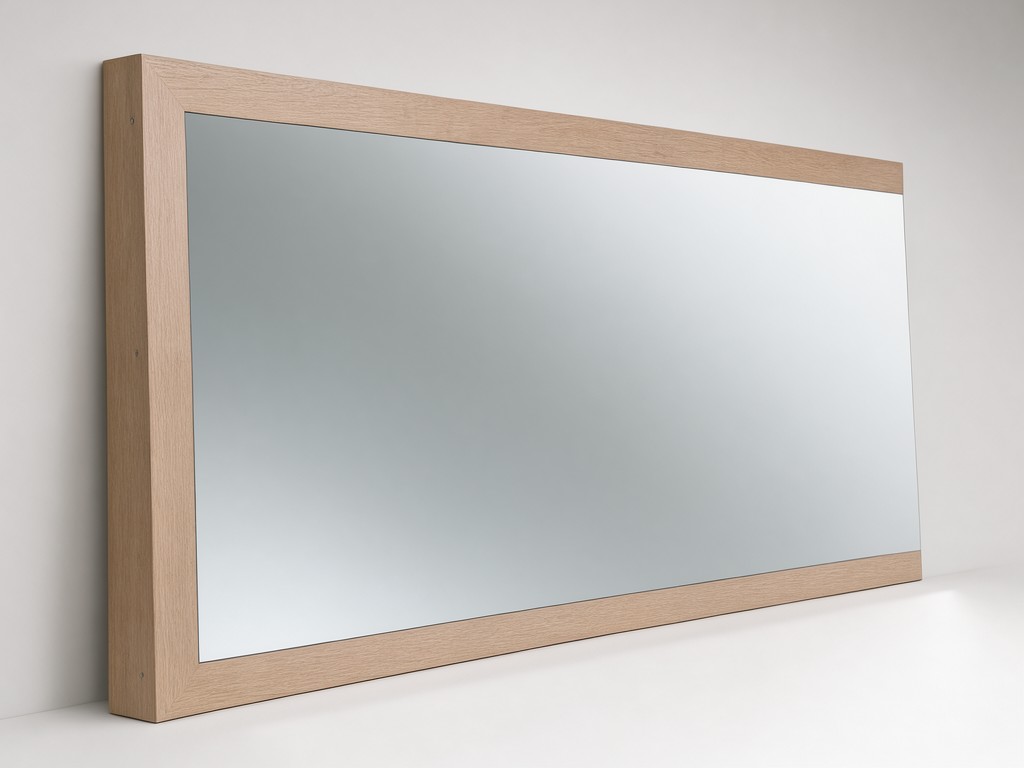
Large gym mirrors ship as float glass or tempered glass, silvered on one face and laminated with a polyethylene terephthalate (PET) safety backing. Standard production runs cover 4 mm, 5 mm and 6 mm thickness, with panel sizes up to 2400 mm by 1200 mm without a centre joint. Frameless panels rely on Z-bar or French cleat systems, while framed builds use extruded aluminium or wrapped MDF. Each step up in thickness adds roughly 10 kg per square metre and changes the freight class.
Specification rule
Above 1500 mm in any dimension, tempered glass with a bonded PET backing is the practical minimum; annealed stock at that size carries a higher breakage rate in transit and after installation.
Customisation stops where freight and installation costs rise faster than unit price. Cutouts for grab bars, non-rectangular shapes, and safety film colours beyond clear or grey require new tooling and extend lead time by two to four weeks. Edge finishing—polished, bevelled or seamed—adds handling steps and changes how panels nest in a crate.
Comparing Two Standard Configurations
4 mm Annealed + PET Backing, Z-Bar Mount
Roughly 10 kg per square metre. Suitable for wall areas under 1.5 m wide in low-impact studios. Cheapest to ship per panel, but higher breakage rate during unloading and no resistance to dropped-weight impact.
6 mm Tempered + PET Backing, Aluminium Frame
About 15 kg per square metre. Tempering changes break behaviour to granular fragments, and the frame protects edges during installation. Freight cost rises, but warranty claims from impact and edge damage drop in commercial gyms.
The price gap between the two configurations is usually 30–50 per cent at the FOB level, but the landed cost difference narrows once breakage replacement and reinstallation labour are priced in. For a reorder programme, the 6 mm framed build typically pays for itself after the first damage cycle.
How to Choose Before Requesting a Quote
- Measure the wall run and confirm the maximum single-panel size the freight route allows. — panels above 2400 mm often need a centre joint or crated LTL freight.
- Identify the impact zone: free-weight area, cardio lane, or dance studio. — free-weight zones justify tempered glass; low-impact zones can use annealed.
- Select mounting hardware matched to wall substrate: concrete, block, or drywall with studs. — Z-bars on drywall require stud reinforcement or pull-out ratings above the panel weight.
- Choose edge and backing finish based on cleaning chemicals used on site. — ammonia cleaners accelerate backing delamination unless the film is fully laminated to the silvering.
Usage Scenarios and Buyer Segments
Commercial gym operators order mirrors for free-weight floors where dropped plates and chalk dust are daily conditions. The glass must survive vibration and resist edge chipping from bumper plates resting against the wall. Boutique yoga and Pilates studios prioritise optical clarity and low distortion, because members use the mirror for alignment correction over long sessions. School PE departments and hotel fitness rooms need panels that survive casual impact and cleaning with facility-grade chemicals without backing failure.
Buyer segments differ in what they accept as a defect. An importer selling to retail looks at carton damage rates and silvering uniformity across a batch. A club purchasing manager measures installation call-backs and mirror distortion complaints quarterly. Both groups reject variations in panel flatness that become visible once the mirror is mounted under gym lighting.
Packing, Marking and Freight Configuration
Large mirrors ship in timber crates or A-frame stillages with polyethylene foam interleaving between panels. Corner protectors and edge tape reduce chipping during forklift handling. Cartons and crates carry batch markings for traceability, and each pallet is marked with panel count, thickness, and orientation arrows. Export documentation should specify tempered status and safety backing presence so receiving warehouses can store panels vertically as required.
| Item | Inspection Standard / Limit | Lead Time / MOQ |
|---|---|---|
| Glass flatness | Maximum bow 1 mm per metre, checked with a straightedge under reflected light. | Sample approval 7–10 days; production 25–35 days. |
| Silvering adhesion | Cross-hatch tape test; no backing lift at scored lines. | MOQ 50 panels per size and thickness; mixed sizes by quote. |
| Panel dimensions | Length and width tolerance ±2 mm; thickness 4/5/6 mm ±0.2 mm. | FCL lead time 30–40 days; LTL crate lead time 20–30 days. |
Next Step: Artwork and Branding Review
Before the first container is booked, send your panel dimensions, backing specification, and mounting hardware list for a production feasibility review. The factory will confirm flatness limits, crate configuration, and the exact MOQ for your size mix.
Inquiry checklist
Panel size and thickness; tempered or annealed; backing film requirement; mounting system; order quantity and delivery port.
Submit your specification sheet to start sampling and pricing.
Request a quotation and sample review