For budget mirror programs, the real cost decision is glass thickness and backing chemistry, not the frame finish.
Three-millimetre float glass with conventional silver backing cuts material and freight weight but develops black edge corrosion within months in a humid bathroom. Four- or five-millimetre copper-free mirror with a moisture-resistant PVC backing costs more per unit and adds dead weight, yet it eliminates the most common warranty claim: silvering failure at the edge. Choose the thinner spec only where turnover is fast and replacement is expected; specify the heavier backing where repeat orders depend on low return rates.
Low Price budget friendly wall mounted bathroom mirror Wholesale: What Buyers Should Check Before Ordering
Consistency depends on glass flatness, silver adhesion, and edge finishing across every batch. A mirror that leaves the press with 0.3 mm of bow reads as distorted above a vanity, and thin silvering oxidizes at the cut edge within a heating season. Buyers should accept only suppliers who can show edge-seal consistency and flatness tolerances in writing before the first production run.
Scope of Supply and Physical Form
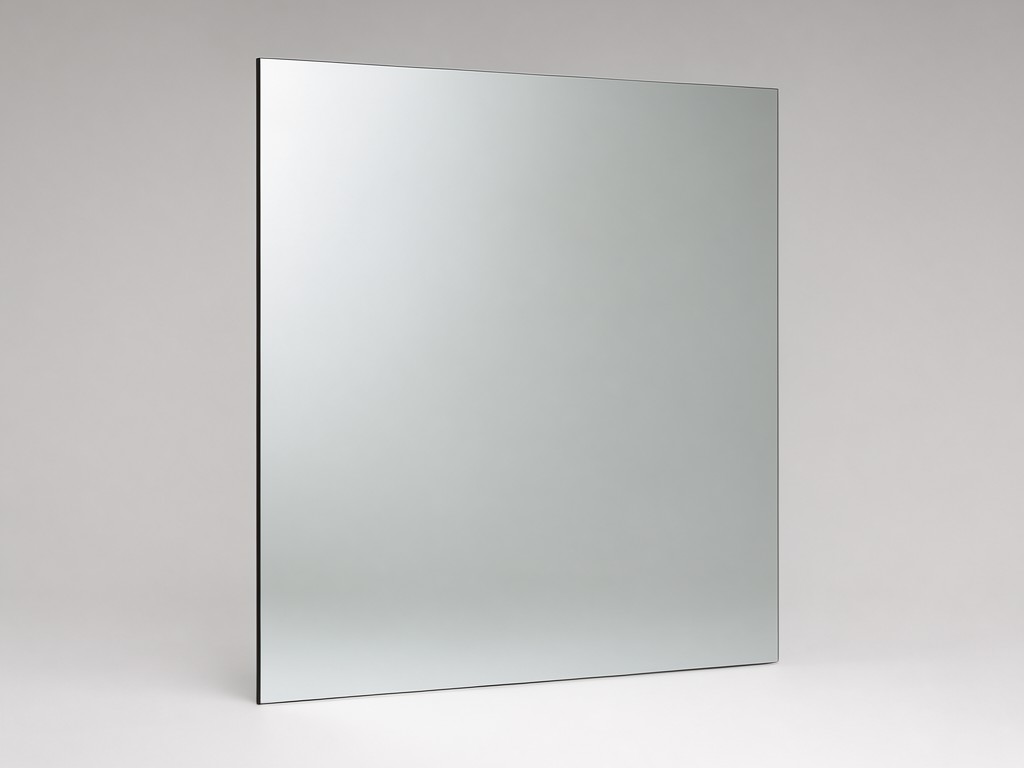
The interface between parts determines whether a wall-mounted mirror stays flat or sags over time. Frameless units rely on wall brackets and adhesive contact; framed units transfer load through an aluminum or MDF surround to the fixing points. A complete supply spec should state mirror thickness, backing board, bracket type, screw gauge, and whether adhesive tape is pre-applied, because missing any one item shifts installation cost to the buyer.
Material Options and Their Trade-offs
Deflection under load governs glass thickness selection for a wall-hung mirror. Three-millimetre glass saves roughly 30 percent on material cost and freight cube, but it flexes under its own weight across a 600 mm span and chips more readily at the cut edge. Four- or five-millimetre glass resists deflection and carries heavier backing without bowing, though it raises the unit weight into a range that requires masonry fixings rather than plasterboard plugs.
Silver backing remains the low-cost default, but it creeps at the edge in bathroom humidity unless the edge is fully sealed. Copper-free backing adds roughly 10 to 15 percent to the glass cost and removes the oxidation pathway entirely. MDF warps when it absorbs moisture; PVC or sealed particleboard holds dimension in wet rooms at a higher sheet cost.
Size, Weight and Specification Range
Edge chip rates rise sharply once glass drops below 4 mm, so stock programs usually start at 400 mm wide and 500 mm high and run to 900 mm by 1200 mm before custom cutting is required. Weight scales with glass thickness and backing choice; a 600 x 800 mm unit in 4 mm glass with PVC backing typically lands near 9 kg, which fixes the fixing specification. Dimensional tolerance should be held within plus or minus 1 mm so brackets line up from one order to the next.
| Specification | Entry Level | Standard | Heavy Duty |
|---|---|---|---|
| Glass thickness | 3 mm float | 4 mm float | 5 mm float |
| Reflective backing | Conventional silver | Copper-free silver | Copper-free silver |
| Backing board / frame | None (frameless) | MDF back panel | Aluminum frame + sealed back |
| Approx. weight (600 x 800 mm) | 5.5 kg | 7.8 kg | 11.2 kg |
| Wall fixing requirement | Plasterboard plugs | Masonry screws | Masonry screws + safety film |
| Custom size tooling | Not available | Available at MOQ | Available at MOQ |
Who Uses It and Where It Matters
Hotel refurbishment programs and student housing specify these mirrors for daily cleaning and occasional impact without edge corrosion. Procurement officers for club or academy changing rooms need a flat, distortion-free surface in high humidity with frequent wall contact. The deciding factor in each case is whether the backing and edge seal can survive condensation without blackening at the perimeter.
Capacity, Tooling and Scheduling
Press capacity and cutting tolerances must remain stable as volume moves from sample to repeat order. Tooling for straight cuts and standard edging is amortized quickly once monthly volume passes a few hundred units, but custom sizes or bevel edges require new glass cutting programs and slower first-article approval. Lead time moves in step with tooling: stock sizes ship in roughly two to three weeks after artwork approval, while custom formats add two to four weeks for die and fixture setup.
| Pack Level | Dimensions (L x W x H, mm) | Units per Carton | Gross Weight (kg) | Pallet Configuration |
|---|---|---|---|---|
| Individual sleeve | 620 x 820 x 25 | 1 | 6.2 | — |
| Inner carton | 640 x 840 x 60 | 4 | 28.0 | — |
| Master carton | 660 x 860 x 130 | 8 | 58.0 | 20 cartons per pallet |
| Export pallet | 1100 x 1100 x 1800 | 160 | 1160 | 20 master cartons, shrink-wrapped |
Request Specification Review
Send your target size, backing preference, and annual volume for a unit-cost breakdown and lead-time confirmation.
Start specification review