Specifying factory direct white framed bathroom vanity mirror factory sale for Wholesale and OEM Orders
Consistency depends on the frame-to-glass interface, not the paint colour. A white frame can hide corner gaps, but it cannot hide a silver backing that lifts at the edge after six months in a bathroom. The working principle is straightforward: float glass receives a silver reflective layer, a copper protective layer, and a backing paint, then sits in a frame that carries the weight and holds the mounting points. Where the frame meets the glass is where repeat warranty claims start.
Buyers judge this product on three numbers: glass thickness, frame squareness, and edge-seal integrity. Four-millimetre glass is standard for vanities under 700 mm wide; anything wider needs five or six millimetres or the glass deflects under its own weight and the frame racks out of square. Aluminium frames resist corrosion but conduct condensation to the wall; MDF frames swell at the mitre if the edge seal fails. There is no neutral choice, only a trade-off between weight, freight cost, and service life.
What Actually Determines Performance
Balance and load analysis shows that a 600 mm by 900 mm panel of 4 mm glass weighs roughly 5.4 kg and can sag 0.5 mm over its span if the frame lacks a centre stiffener. At 5 mm the same panel weighs 6.8 kg and resists deflection better, but adds 25 percent to the per-unit freight weight across a pallet of fifty units.
Specification rule: specify edge sealant before frame finish. A frame painted over unsealed glass edges traps moisture against the silver coating and causes desilvering within the first heating season.
Measured Performance in Real Use
Deflection under load governs whether a mirror stays flat or develops a bow that shows in the reflection. Glass thickness is only one variable; frame depth, mounting hardware spacing, and wall flatness all change how much stress reaches the silver backing.
| Component | Standard Specification | Upgrade Option | Failure Mode When Under-Specified |
|---|---|---|---|
| Glass | 4 mm float glass, flat polish edge | 5 mm or 6 mm tempered glass | Deflection, edge chip, distortion in reflection |
| Frame | White powder-coated aluminium extrusion | Solid wood or upgraded gauge aluminium | Mitre separation, corrosion at joints, finish chalking |
| Backing | Silver + copper + white backing paint | Enhanced corrosion-resistant backing | Desilvering at edges, black spots after humidity exposure |
| Edge seal | Silicone or polyurethane edge sealant | Dual-seal with moisture barrier | Moisture ingress, backing lift, frame swelling |
| Mounting | D-ring and wire, 2-point | French cleat or keyhole slot | Mirror tilt, hardware pull-out, wall damage |
| Humidity tolerance | 60–80 % RH, non-condensing | Sealed unit for high-moisture zones | Coating failure, frame mould, adhesive breakdown |
Component choices map to the failure mode each one prevents. A buyer sourcing for a hotel chain typically accepts 5 mm glass and an aluminium frame because the replacement cost of a single desilvered unit exceeds the unit price difference. A buyer sourcing for a budget flat-pack line may stay at 4 mm and MDF, provided the edge seal is applied at the factory and not left to the installer.
Assumptions Buyers Should Stop Making
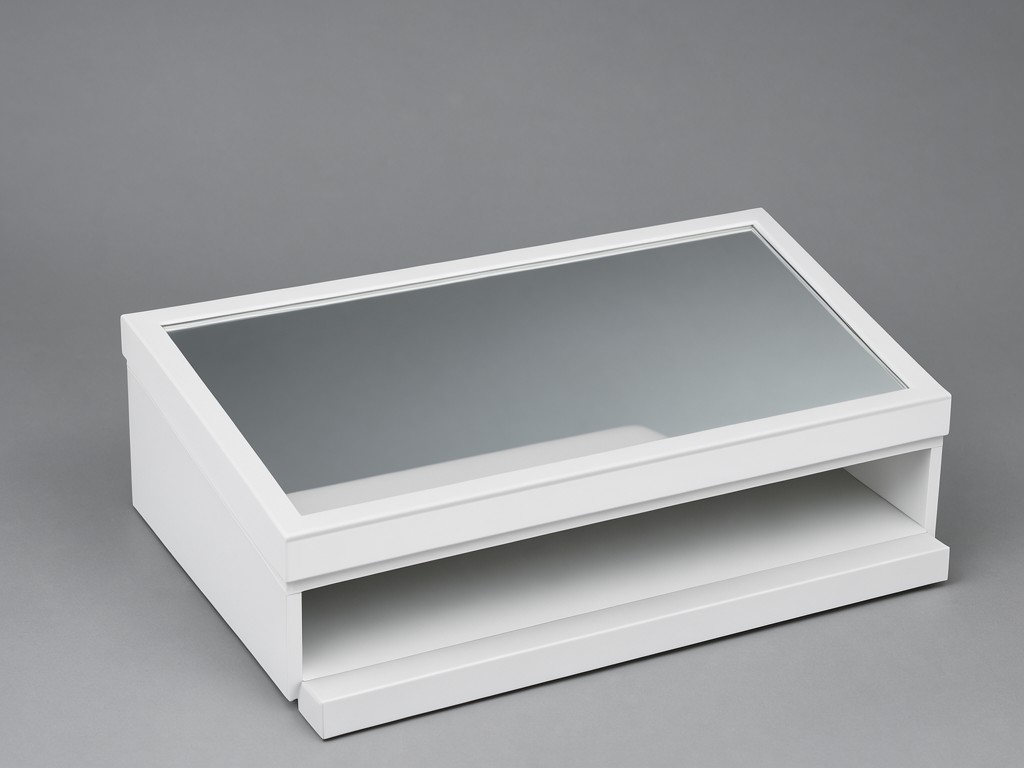
One common assumption is that “white framed” means the same material across factories. One supplier may use powder-coated aluminium; another may use wrapped MDF with a paper foil. Both look white in a product photo, but only one survives repeated humidity cycles without edge swelling. The second fails at the mitre joint first, usually where the frame is shortest and the stress concentrates.
Another mistake is assuming the mirror mounts directly to the wall without considering vanity depth. If the vanity protrudes 200 mm from the wall, a standard D-ring placement may leave the mirror tilted forward or pressed against the splashback. Frame depth and hanging hardware spacing must be confirmed against the vanity drawing before tooling is cut.
What Can Be Customised and What Cannot
Customisation runs into tooling cost quickly. Frame profile changes require a new extrusion die or a new wood mould; glass edgework changes require a different edging machine setup. The following decision tree separates real options from cost traps.
- Glass thickness
- 4 mm — standard for panels under 700 mm; lowest freight weight.
- 5 mm — recommended for 700–900 mm; adds roughly 1.4 kg per square metre.
- 6 mm — required above 900 mm or for pivot mounts; increases cost and handling breakage risk.
- Frame material
- Aluminium extrusion — corrosion resistant, lighter, higher tooling cost.
- MDF with foil wrap — lower unit cost, swells if edge seal fails, not for steam rooms.
- Solid wood — heaviest, highest finish variation, longest lead time.
- Mounting hardware
- D-ring and wire — simplest, least expensive, limited to lighter panels.
- Keyhole slots — better for larger panels, requires precise frame routing.
- French cleat — strongest, easiest to level, adds frame depth.
- Branding
- Etched logo on glass corner — permanent, no adhesion failure, higher per-unit cost.
- Silk-screen on frame — cheaper, can wear at corners with repeated cleaning.
- What cannot be changed without new tooling
- Glass substrate after the silver coating line is set; changing thickness means a new cutting and edging schedule.
- Backing paint colour if the line runs a standard white or grey batch.
- Wall thickness of the frame channel without a new die or mould.
What Gets Checked Before Shipment
Inspection happens at three points: incoming glass, frame assembly, and finished mirror. Glass is checked for flatness, edge chip, and thickness within ±0.2 mm. Frames are checked for mitre gap (no more than 0.5 mm at any corner) and finish adhesion with a cross-hatch tape test. Finished mirrors receive a silver backing adhesion check, a weight verification, and a dimensional check against the approved sample.
Sampling follows an AQL plan agreed before production. Critical defects—silver desilvering, frame corrosion at the joint, mounting hardware pull-out—trigger a full lot review. Minor defects—micro-scratches in the frame finish, slight colour variation in the white paint—are accepted within the agreed percentage. Batch traceability records link each pallet to the glass run and frame lot so a repeat complaint can be traced to its source.
Packaging is part of the inspection. Mirrors travel face-to-face with foam separators, edge protectors, and corner cards. A drop test on a packaged sample confirms whether the corner protection survives a pallet handling incident. If it does not, the packaging specification changes before the order ships.
Care, Storage and Service Life
Service life is set by the weakest layer, usually the edge seal or the backing paint. Store mirrors flat in a dry area; leaning them against a wall concentrates weight on one edge and can warp the frame over weeks. Clean with a soft cloth and water or a glass cleaner without ammonia. Ammonia attacks the silver backing at the edges and voids the warranty.
Expected service life in a ventilated bathroom is five to eight years with 4 mm glass and a sealed aluminium frame; in a steam shower without mechanical ventilation, replace that estimate with two to three years regardless of frame material. Warranty terms cover manufacturing defects in glass, frame, and coating, not damage from incorrect cleaning agents or installation into a wet zone without an extractor fan.
Request a tooling review and sample approval
Send your vanity drawing, required glass thickness, and annual volume. We will confirm frame compatibility, edge-seal specification, and freight weight per pallet before tooling is cut.
Start inquiry






