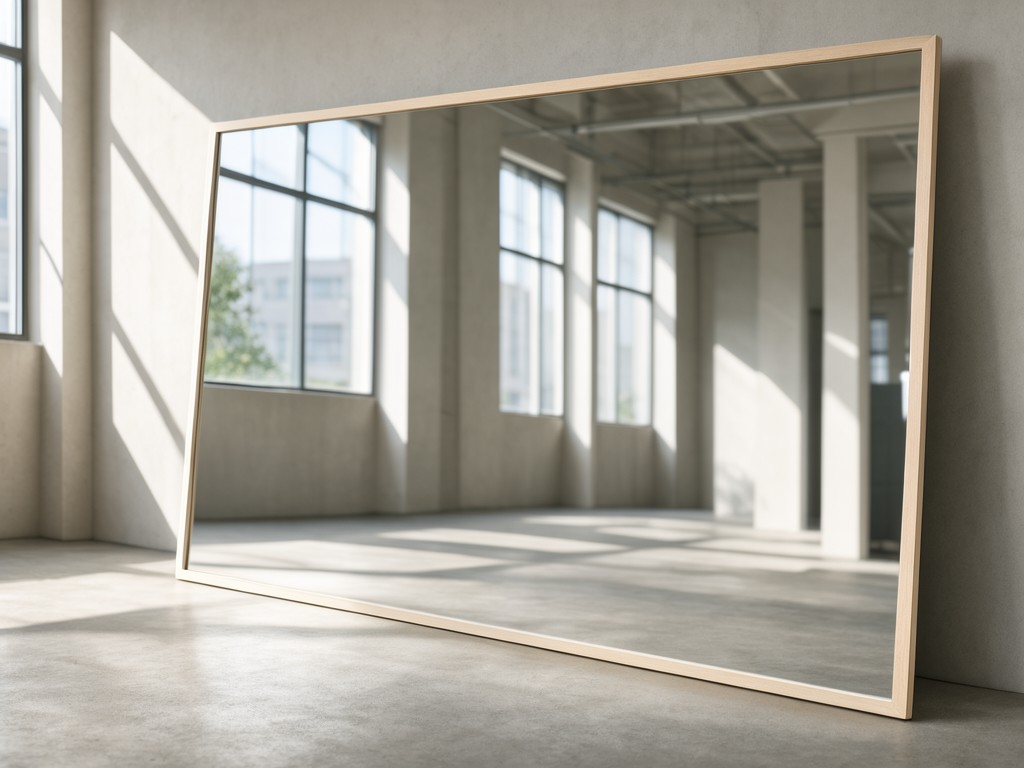
factory direct large wall mounted bedroom mirror factory: What Buyers Should Check Before Ordering
First-article tooling determines the dimensional accuracy of the edge-cut. If the CNC glass cutter deviates by more than 0.5mm, the frame assembly fails to seat flush, creating structural stress points that lead to hairline fractures over time. For large-format bedroom mirrors, the tolerance between the glass edge and the frame channel dictates whether the unit remains flat or develops bowing under its own weight.
What the Design Has to Balance
Consistency is set at the forming stage where the silvering emulsion is applied to the glass substrate. A 4mm float glass reduces material cost but increases the risk of the "funhouse effect"—optical distortion—in spans exceeding 1200mm. To maintain optical clarity in large installations, 5mm or 6mm glass is required, though this increases the load-bearing requirements on the mounting hardware.
Weight-to-Hardware Ratio
The density of the glass determines the choice of mounting hardware. Standard D-rings often fail for heavy 6mm mirrors; French cleats or reinforced aluminum Z-clips prevent the mirror from sliding or shearing due to thermal expansion.
Buying Mistakes That Lead to Returns
Process choice shows up later as the durability of the mirror surface. Many buyers overlook the edge-sealing process, which is the primary defense against silver rot—black oxidation appearing at the edges in high-humidity bedroom environments. Selecting a copper-backed silvering with a paint-sealed edge mitigates this risk by preventing moisture ingress.
| Usage Condition | Typical Failure | Preventive Specification |
|---|---|---|
| High humidity / Coastal areas | Silver rot and oxidation spots | Copper-backed silvering with epoxy edge sealant |
| Large-span wall mount | Frame bowing or warping | Reinforced aluminum-channel or Z-cleat |
| High-impact zones | Shattering glass | Tempered glass or safety-backed PET film |
Segment-Specific Requirements
Residential retail buyers prioritize aesthetic finish and ease of installation, often utilizing MDF frames with lightweight wood veneers. Conversely, commercial-grade hospitality mirrors require impact-resistant glass and robust metal frames that can withstand frequent cleaning cycles. The specification must align with the end-user's environment to ensure long-term surface integrity.
OEM and ODM Programme Structure
The specification approval process begins with CAD drawings that define exact tolerances and material compositions. Before mass production, we provide physical mock-samples to verify the glass reflection index and frame joint strength. Once the buyer signs off on the technical datasheet, the parameters are locked to ensure batch consistency across multiple orders.
For custom branding or specialized frame hardware, review our technical capabilities here.
Export Packaging and Handling Protection
Transporting large-format mirrors requires a packaging strategy that prevents vibration-induced fractures. We utilize high-density PE foam inserts custom-cut to the mirror dimensions, housed within reinforced plywood crates. Each mirror is wrapped in a moisture-barrier film to prevent condensation-related silver damage during long-distance sea freight.
Need a custom technical specification for your bulk order?
Request a specification-review






