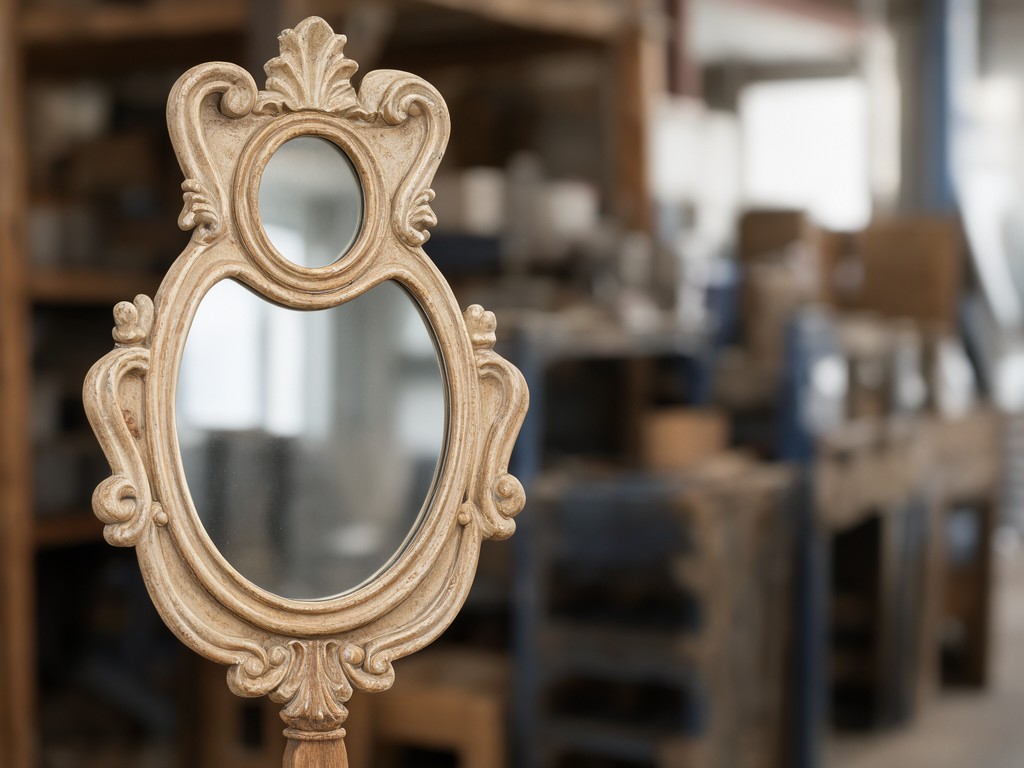
B2B vintage cartouche frame mirror Exporter: What Buyers Should Check Before Ordering
The build method decides the structural integrity of the cartouche. While resin-molded frames offer lower unit costs, they lack the fine tensile detail found in hand-carved basswood alternatives. Choose hand-carved wood for high-end hospitality projects where tactile texture and longevity are the primary procurement metrics.
Scope of Supply and Physical Form
Humidity fluctuations cause expansion and contraction in timber-based frames. We utilize moisture-stabilized wood to prevent the frame from warping away from the glass substrate over seasonal shifts. Specify moisture-stabilized timber for regions with high relative humidity to maintain dimensional stability.
Glass Specification
Standard units utilize 4mm to 6mm silvered float glass. Thicker glass reduces the probability of stress fractures during long-haul shipping compared to thinner 3mm variants.
Frame Depth
Frames typically range from 20mm to 60mm in depth. Deeper profiles provide more surface area for secure mounting hardware in large-scale installations.
Mounting Hardware
Heavy-duty mirrors require D-rings or French cleat brackets. These components ensure the weight is distributed evenly across the rear frame perimeter.
Where Cheaper Alternatives Fall Short
Aggressive cleaning agents strip standard metallic paints off low-cost frames. We apply a multi-layer polyurethane overcoat to shield the leafing from chemical abrasion. Request polymer-coated finishes for retail environments where frequent dusting is required.
Low-grade adhesives often delaminate at the glass line under thermal stress. Our process uses industrial epoxy resins to maintain a permanent bond between the frame and the mirror. Prioritize epoxy-bonded joints to reduce return rates related to frame-glass separation.
| Feature | Budget-Grade Option | Industrial-Standard |
|---|---|---|
| Frame Material | Molded Poly | Carved Wood / Cast Metal |
| Surface Finish | Metallic Paint | Gold/Silver Leaf |
| Mirroring | Standard Silvering | Oxidation-Resistant Backing |
How It Performs in Use
High humidity triggers oxidation of the silvered backing; therefore, a copper-oxide barrier is used to prevent black spotting in damp environments. These copper-backed mirrors are ideal for bathroom or coastal-location contracts.
UV exposure fades organic pigments in vintage-style patinas. We utilize UV-stabilized mineral pigments to maintain color saturation over five years of direct light exposure. Select mineral-based finishes for mirrors placed near south-facing windows.
Customisation Options and Their Limits
Custom frame dimensions increase the lead time due to the need for bespoke structural supports. Orders exceeding 1200mm in width require internal ribs to prevent glass from bowing under gravity. Stick to standard sizing for bulk orders requiring consistent shipping schedules.
| Option | Available Range | Technical Limit |
|---|---|---|
| Size | 300mm - 2400mm | Weight reinforcement needed after 15kg |
| Finish Type | Antique, Aged, Raw | Hand-leafing requires higher MOQ |
| Glass Type | Clear, Tinted, Beveled | Bevel increases weight significantly |
Who Uses It and Where It Matters
Hospitality procurement requires mirrors that can withstand high-frequency cleaning cycles. Our reinforced frames handle the impact of ammonia-based cleaners without degrading the decorative finish. Specify reinforced-edge frames for high-traffic hotel corridors.
Interior designers for residential developments utilize cartouche frames to create focal points in entryways. The weight of the unit dictates the choice of mounting hardware to ensure safety compliance. Ensure French cleat hardware is specified for all-glass units over 10kg.
Ready to review technical data sheets or request a wholesale quote?
Review full specifications and export pricing.






