factory direct metal framed bathroom vanity mirrors exporter: What Buyers Should Check Before Ordering
Construction options diverge as soon as weight matters. When sourcing large-format vanity mirrors, the structural integrity of the metal frame dictates the allowable glass-thickness-to-frame-weight ratio. A thin frame may fail to support 6mm tempered glass, leading to stress fractures that compromise the optical clarity over time. Procurement officers must evaluate the gauge of the metal used to ensure the assembly remains flat against the wall despite thermal fluctuations in bathroom environments.
Design Constraints Behind the Specification
Bathroom environments involve high humidity and chemical vapor exposure. Standard mirrors often suffer from "black edge" or silvering rot when moisture penetrates the glass-metal interface. To mitigate this, the specification must include a moisture-resistant back coating and a frame design that seals the glass edges. The frame's profile extrusion or casting method also determines how well the joints resist separation at the corners where moisture tends to accumulate.
Material choice starts with the conditions the product will meet. For high-volume residential projects, powder-coated aluminum offers a balanced cost-to-weight ratio. However, for commercial hospitality projects in coastal regions, grade 304 stainless steel is required to prevent corrosion from salt air and aggressive cleaning agents. The surface finish—whether electro-plated, powder-coated, or brushed—affects the resistance to abrasion and scratching over years of maintenance cycles.
The optical performance of the mirror depends primarily on the silvering process and the thickness of the glass substrate. High-density silvering provides a reflection rate typically above 92%, which minimizes color distortion in vanity settings. If the glass is low-grade, the reflection may exhibit a greenish or grey tint, reducing the perceived value of the retail product. Buyers should specify clear-5mm or 6mm glass to ensure color neutrality across different lighting temperatures.
| Feature | Aluminum Extruded | Stainless Steel (304) |
|---|---|---|
| Corrosion Resistance | Good (with coating) | Excellent (inherent) |
| Structural Weight | Light | Heavy |
| Unit Cost Point | Low | High |
The manufacturing method directly impacts batch consistency across large orders. Extruded frames provide high dimensional tolerance across thousands of units, ensuring that multi-mirror installations align perfectly. In contrast, cast frames allow for more decorative shapes but may exhibit porosity or shrinkage if the cooling process is not strictly controlled. For OEM buyers seeking a consistent aesthetic, the extrusion process ensures that the 1,000th unit is identical to the first sample.
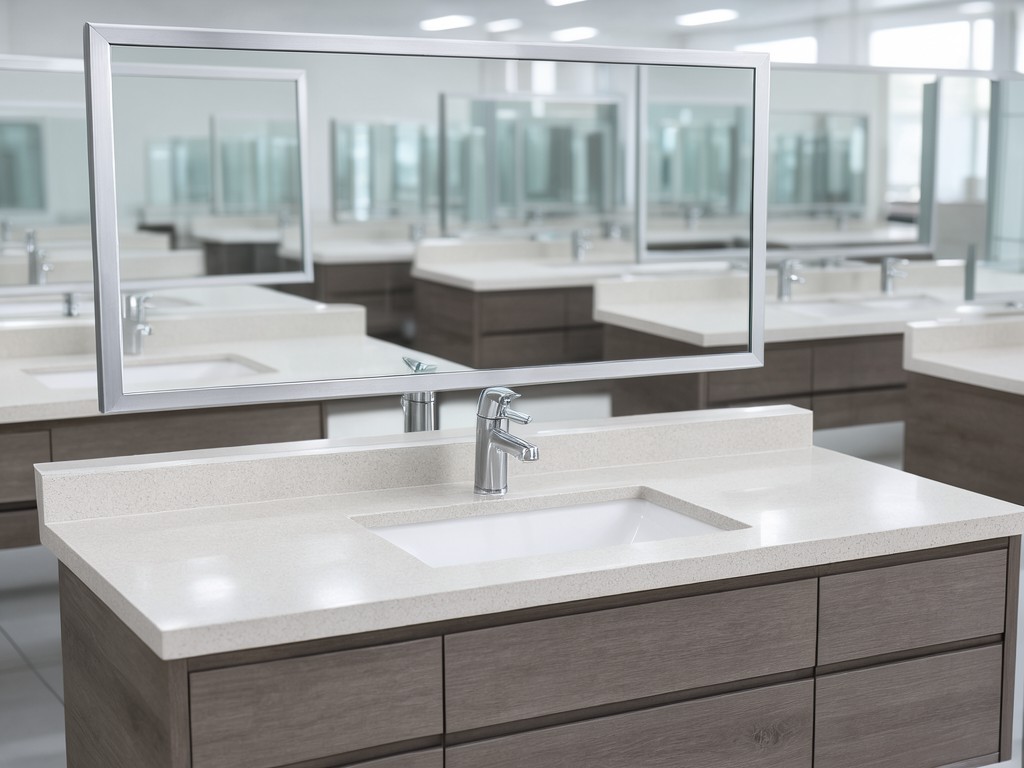
| Parameter | Standard Range | Custom Options |
|---|---|---|
| Mirror Width | 400mm - 1200mm | Custom CNC cutting available |
| Frame Thickness | 10mm - 50mm | Custom profile extrusion |
| MOQ | 500 units | Negotiable based on tooling |
| Lead Time | 30-45 days | 60+ days for custom |
Cost and durability pull in opposite directions once unit price impacts the return rate. A lower-cost frame often utilizes a thinner powder coating that is prone to peeling within 24 months of a high-humidity bathroom. For retail buyers, the cost of a warranty claim or a replacement mirror far exceeds the initial savings. Investing in a thicker micron-level coating and a zinc-grade alloy reduces the total cost of ownership by eliminating maintenance-related returns.
Matching the product to the buyer's need requires a clear understanding of the end-use environment. A hotel developer prioritizes ease of installation and durable mounting hardware to reduce labor during renovations. A luxury residential brand focuses on the finish quality and the optical distortion of the glass. The exporter must specify the hardware used—such as Z-clips or French-cle cleats—to ensure the mirror can handle the specific load of the chosen frame material.
- Commercial Hospitality: Requires high-impact resistance glass and rapid-install mounting systems.
- Retail Chains: Focuses on trend-driven frame finishes and cost-effective retail-ready packaging.
- Luxury Residential: Demands bespoke dimensions and premium metal finishes like PVD or brushed brass.
Quality Control and Batch Consistency
Batch consistency is maintained through rigorous testing protocols before shipment. We utilize salt spray testing on frame samples to ensure the coating will not de-aminate under exposure to bathroom vapors. Dimensional checks are performed on every 50th unit to ensure the frame square remains within a ±1.5mm tolerance, preventing gaps when multiple mirrors are mounted together. Furthermore, the silvering is inspected under polarized light to ensure no pitting or uneven application exists across the production run.
Ready to discuss your private-label mirror specifications?
Request an artwork and branding review today






