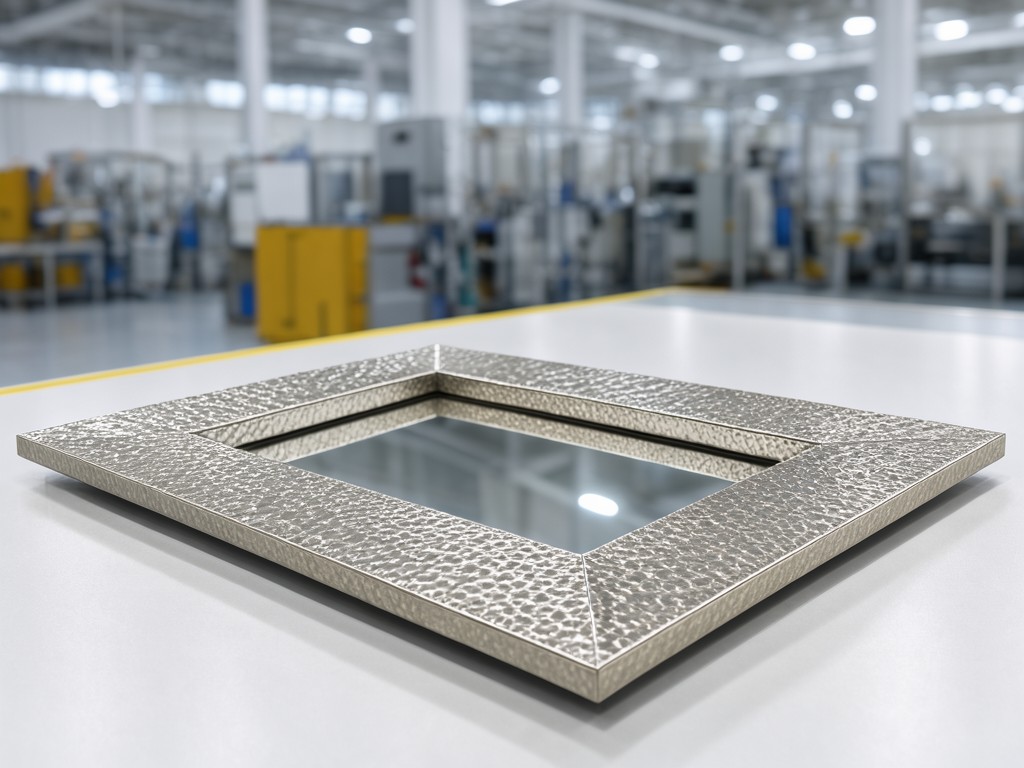
Custom Hammered Metal Frame Manufacturer - Bulk Supply and Specification Guide
During a private-label launch with a fixed ship date, the primary failure point is often the structural integrity of the frame relative to glass weight. Many wholesale suppliers utilize thin-gauge aluminum to save on freight, but these frames often bow under the load of 6mm float glass. This mechanical deformation leads to silvering cracks at the edges and misalignment of the mounting hardware during final installation. Our manufacturing process focuses on matching frame wall thickness to specific glass densities to ensure the unit remains square throughout the shipping cycle and service life.
Where Cheaper Alternatives Fall Short
Low-cost alternatives frequently rely on stamped metal with a printed-texture finish rather than genuine hammered metal. This surface finish delaminates when the mirror is placed in a high-humidity environment, as the adhesive bond between the coating and the metal substrate fails under thermal expansion. We utilize solid-cast zinc alloy or wrought steel where the hammered texture is integrated into the material itself. This prevents the "peeling" effect seen in budget-grade imports after multiple seasonal temperature shifts.
Technical Tolerance Note
Standard hammered frames maintain a dimensional tolerance of ±1.5mm. For oversized-format mirrors exceeding 1200mm in height, we implement internal cross-bracing to prevent gravity-induced sag.
Material Options and Their Trade-offs
Selecting the right alloy depends on the retail price point and the intended installation environment. Use the following logic to determine the specification for your order:
-
If the project requires high load-bearing capacity (>20kg):
- Select Wrought Iron. It provides the highest rigidity but increases per-unit freight costs by approximately 40% compared to zinc.
-
If the priority is intricate texture detail at medium weight:
- Select Cast Zinc Alloy. This allows for deep hammered patterns that remain consistent across 500+ unit batches.
-
If the budget focuses on weight-sensitive retail shipping:
- Select Powder-coated Aluminum. It offers the lowest mass but requires a minimum 3mm wall thickness to prevent frame warping.
Comparing Two Standard Configurations
| Specification | Standard Residential Series | Premium Commercial Series |
|---|---|---|
| Frame Material | Molded Zinc | Hand-Wrought Steel |
| Glass Thickness | 4mm Silvered | 6mm Low-Iron Clear |
| Finish Process | Electrostatic Powder | Multi-layer Antique Leaf Buff |
| Mounting Hardware | Standard D-Rings | Heavy-duty French Cleat |
Assumptions Buyers Should Stop Making
Buyers often assume that the hammered texture is uniform across an entire production run. In reality, manual-hammering creates variations in depth that affect light reflection. To maintain batch consistency for wholesale orders, we use master templates to guide the impact points, ensuring that the shadow-gap remains within a 0.2mm variance across the entire container-load.
Another common misconception is that the frame material is the only factor in corrosion resistance. In coastal retail environments, the interface between the metal frame and the glass is the primary site of oxidation. We specify a silicone-based gasket between the two components to prevent moisture from reaching the silvered edge, which prevents the "black spot" corrosion common in cheaper mirrors.
Working as a Production Partner, Not a Catalogue Supplier
Moving from sample orders to container loads requires a shift from aesthetic preference to engineering specifications. Our team works with technical drawings that define the exact center of gravity for each mirror, which is critical for your retail hardware compatibility. By finalizing these tolerances before the first mold is cast, we eliminate the risk of receiving a bulk shipment that deviates from the approved prototype. You can discuss your project-specific tolerances here.
Capacity, Tooling and Scheduling
Custom tooling for unique hammered patterns requires a lead time of 4-6 weeks for die-making and stress testing. Once the tooling is validated, our production capacity allows for 2,000 units per month for standard-sized frames. We schedule production based on the cooling rates of the metal alloys; rushing this process creates internal stresses that compromise the structural integrity of the frame, leading to hairline fractures in the joints.
Stock Availability and Reorder Planning
| Packaging Method | Protection Level | Recommended Capacity |
|---|---|---|
| Standard Corrugated Wrap | Medium | Under 500 units/pallet |
| Reinforced Wood Pallet Crate | High (Impact Resistant) | Full Container Export |
| EPE Foam Molded | Premium (Vibration Damp) | Boutique Retail Orders |







