Buy brushed metal black iron Supplier - Bulk Supply and Specification Guide
Scope of Supply and Physical Form
| Parameter | Standard Range | Custom Limit |
|---|---|---|
| Frame Substrate | Cold-rolled black iron | Stainless steel options |
| Glass Thickness | 4mm - 6mm | Up to 8mm tempered |
| Surface Treatment | Mechanical brushed-effect | PVD coating |
| Silvering Type | High-clarity copper | Anti-tinted silver |
Production of black iron frames requires precise structural welding to prevent optical distortion in the glass mounting plane. The process begins with laser-cutting iron profiles, followed by robotic welding to ensure squareness within 0.5mm tolerances. This rigidity ensures that the mirror remains remains flat across large surface areas. For bulk-tier retail orders, the density of the frame determines the maximum load capacity the wall brackets can support without sagging.
Material Options and Their Trade-offs
Cost and durability pull in opposite directions once the environment exceeds low humidity levels. Black iron provides a lower price point for residential projects but necessitates a robust barrier coating to prevent oxidation. Stainless steel eliminates the risk of rust but increases the unit price significantly due to raw material costs.
Powder-Coated Iron
This method utilizes a multi-layer polymer coating to seal the iron substrate. It offers high resistance to scratches and impact. However, if the coating is chipped, moisture can reach the iron and cause localized corrosion.
PVD Brushed Finish
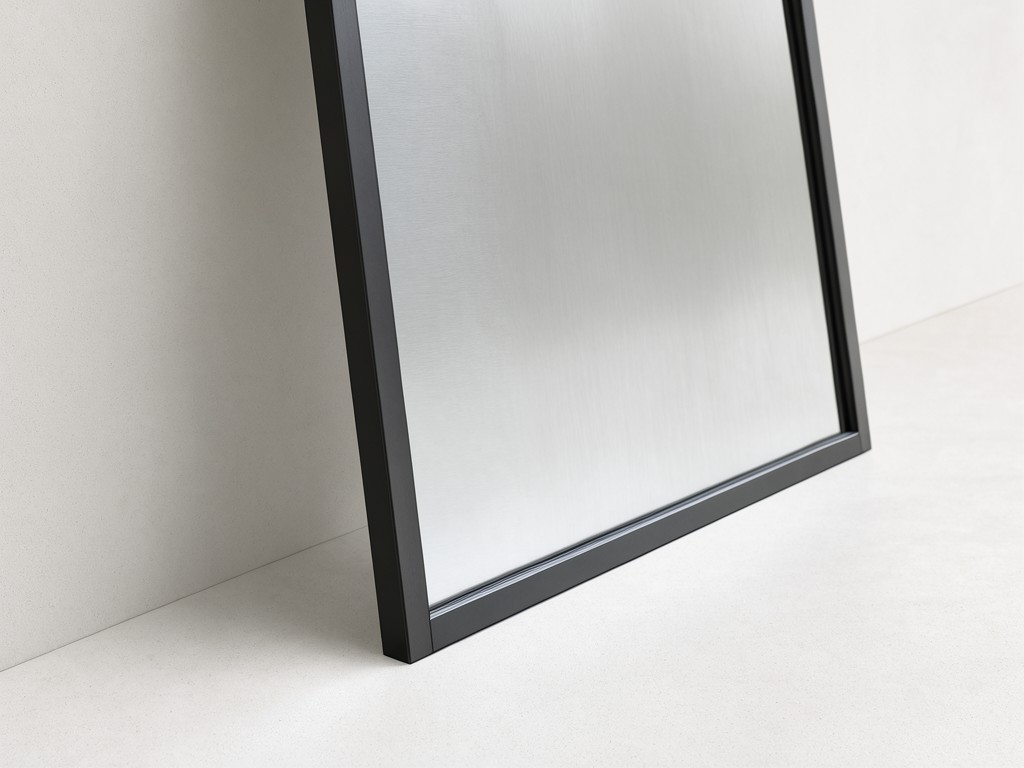
Physical Vapor Deposition creates a thin metallic layer bonded to the surface. This result provides superior wear resistance and a more authentic metallic aesthetic. The tooling amortisation for PVD processes requires a higher initial order volume.
Technical Note: Large-format mirrors exceeding 2000mm in height require 6mm glass to prevent edge-stress induced fractures caused by thermal expansion.
What Can Be Customised and What Cannot
Customization focuses primarily on the frame profile and the specific texture of the brushed metal. Buyers can adjust the width and depth of the iron cross-section to match specific architectural design requirements. However, the chemical composition of the silvering remains limited to standard grades to ensure consistent reflectivity across a batch.
- Custom frame widths from 15mm to 100mm
- Brushed direction (horizontal, vertical, or radial)
- Specific RAL-matched powder-coated finishes
- Hardware-integrated points for recessed mounting
Segment-Specific Requirements
Where chlorine, sweat or UV exposure is routine, the silvering specification must change. Bathroom-grade mirrors require a moisture-resistant backing to prevent black spot corrosion at the glass edges. Standard residential-grade mirrors often fail in these environments within 24 months due to water vapor penetration.
Retail-focused importers prioritize weight-to-size ratios to optimize logistics costs. Using 4mm glass reduces the shipping weight by approximately 15% compared to 6mm glass but increases the breakage rate during high-velocity handling.
Volume Planning and Lead Time
Lead times fluctuate based on the availability of raw iron profiles and the oven capacity. Orders under 500 units typically utilize existing tooling, resulting in a 30-day lead time. Orders exceeding 2000 units allow for custom profile extrusion fabrication, which adds 21 days to the initial setup but reduces the unit cost significantly.
Packing, Marking and Freight Configuration
Export protection involves heavy-duty wooden crates with internal foam bracing to prevent frame-shift. Each unit is wrapped in anti-static polyethylene film to prevent abrasion of the brushed metal surface during transit. Labeling includes batch traceability numbers and fragile-handling indicators to ensure compliance with international freight standards.
Inquire About Samples
Evaluate the material quality and coating adhesion before committing to bulk orders.
Request Sample






