wholesale rounded bottom irregular wall mirrors supplier: What Buyers Should Check Before Ordering
Most quality disputes start with a consistency gap. When sourcing irregular geometries, the primary failure point is often the deviation in the radius curve or the uniformity of the silvering at the cut edges. Wholesale buyers frequently find that low-cost samples hide dimensional inconsistencies that only appear during mass production, leading to misalignment in large-scale hotel or retail installations.
What Actually Determines Performance
| Parameter | Technical Specification Range |
|---|---|
| Glass Thickness | 4mm (standard) to 6mm (high-impact commercial) |
| Dimensional Tolerance | ±1.0mm to ±1.5mm on irregular curves |
| Silvering Process | Copper-backed silvering with protective oxidation coating |
| Edge Finish | Flat polish, beveled, or pencil-frosted edges |
| Backing Material | Erosion-resistant PVC or anti-corrosion paint |
The optical clarity of the mirror depends on the flatness of the float glass. In irregular rounded bottom designs, the stress points during the cutting process can cause micro-fractures if the machine pressure is not calibrated. Using CNC-guided cutting ensures that the rounded bottom maintains a consistent radius across thousands of units, preventing the visual distortion often seen in hand-cut alternatives.
Usage Scenarios and Buyer Segments
Commercial Hospitality & Retail
In high-traffic hotel lobbies or boutique retail environments, the priority is resistance to cleaning agents and impact. A 6mm thickness is preferred here to prevent shattering from accidental contact, while an anti-corrosion backing prevents the black spots caused by humidity in indoor-environments.
Fitness & Wellness Centers
Gyms and pool areas demand extreme moisture resistance. Mirrors in these sectors require a specialized edge-sealing process to stop oxidation. Without this, the irregular edges are prone to delamination within 12 months of exposure to steam.
OEM and ODM Programme Structure
Technical Note: All irregular designs begin with a CAD-based DXF file. We require a minimum corner radius of 10mm to ensure the CNC cutting head can navigate the rounded bottom geometry without causing edge chipping.
Custom-labeling and frame integration are handled during the secondary stage. We provide a prototype approval phase where a physical sample of the irregular shape is sent to the buyer to verify the reflection quality and edge profile. This step ensures that the specific aesthetic of the rounded bottom design matches the brand's architectural requirements before the full-scale run begins.
What Gets Checked Before Shipment
Quality control focuses on the structural integrity of the irregular edges and the uniformity of the surface. We monitor for "bubbles" in the silvering, which indicate contamination in the cleanroom during the vacuum-deposition phase.
| Test Method | Acceptance Criteria |
|---|---|
| Visual Inspection | Zero scratches, pits, or silvering voids |
| Dimensional Check | Radius curve within ±1.5mm of CAD template |
| Adhesion Test | No delamination under 48h humidity exposure |
| Edge Integrity | No chipping or fractures on the irregular perimeter |
Capacity, Tooling and Scheduling
Production capacity is dictated by the complexity of the irregular path. While rectangular mirrors are high-volume, rounded-bottom designs require dedicated CNC cycle time. We typically schedule production in batches of 500 units to maintain tooling calibration for the specific radius. Lead times for custom irregular orders range from 3 to 6 weeks depending on the glass thickness and specialized edge coating requirements.
Export Packaging and Handling Protection
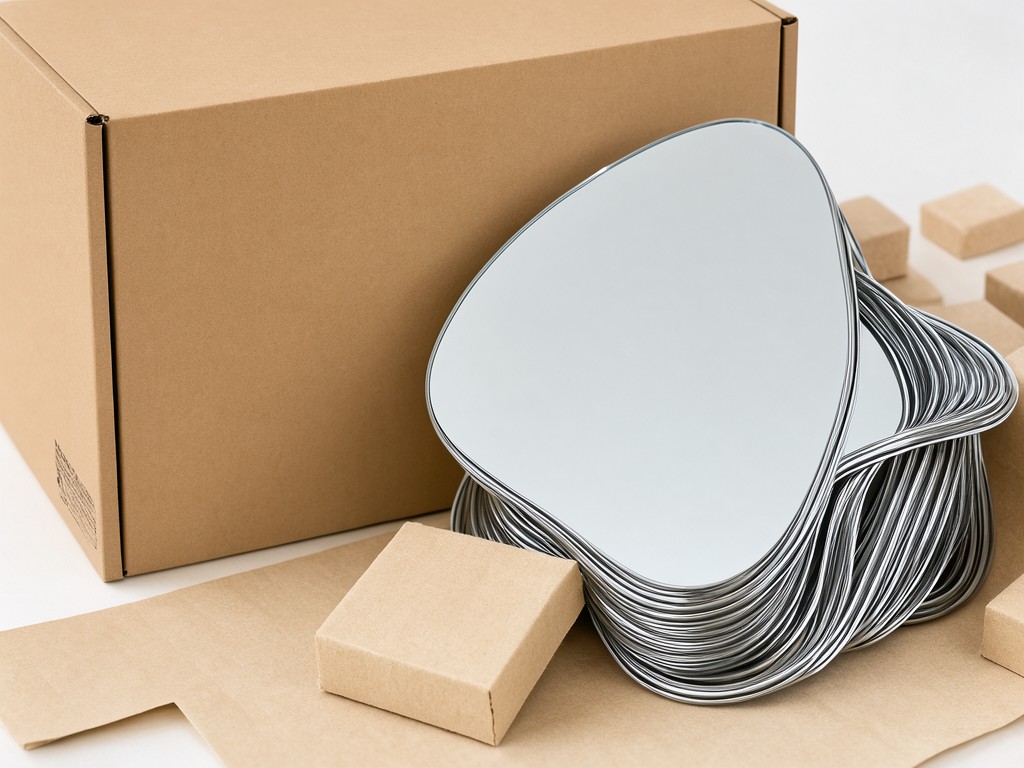
Irregular shapes are more susceptible to stress fractures during transit than standard rectangles. We utilize custom-cut wooden crates with high-density foam inserts that mirror the geometry of the product. Each mirror is individually wrapped in non-abras polyethylene film to prevent surface scratching during long-haul transit, where temperature fluctuations can cause condensation between layers.
Setup, Use and Replacement Parts
Maintenance involves the use of ammonia-free cleaners which can degrade the silvering over time. For installation, heavy-duty French clips or recessed brackets are recommended to distribute weight evenly across the irregular frame. If a unit is damaged during installation, the modular nature of our wholesale supply allows for the replacement of individual glass panels without replacing the entire architectural assembly.
Ordering, Tooling and Lead-Time Questions
What is the minimum order quantity for custom irregular shapes?
The MOQ is typically 200 units to offset the CNC programming and specialized jig setup costs.
Can you provide technical drawings for our installation team?
Yes, we provide DXF and PDF files for every approved irregular design, including precise radius measurements.
How is the silvering protected in high-humidity zones?
Standard mirrors use an anti-corrosion paint layer; for bathrooms, we apply an additional edge sealant to prevent oxidation.







