Specifying direct factory large scalloped decorative wall mirror factory for Wholesale and OEM Orders
Technical Trade-off: The primary trade-off in large scalloped mirrors centers on frame density and shipping-related breakage risk. Utilizing MDF (medium-density fiberboard) reduces weight and freight costs by 30% compared to solid wood but requires reinforced edge-sealing to prevent moisture-induced delamination during high-humidity international transit.
How It Is Built and What That Changes
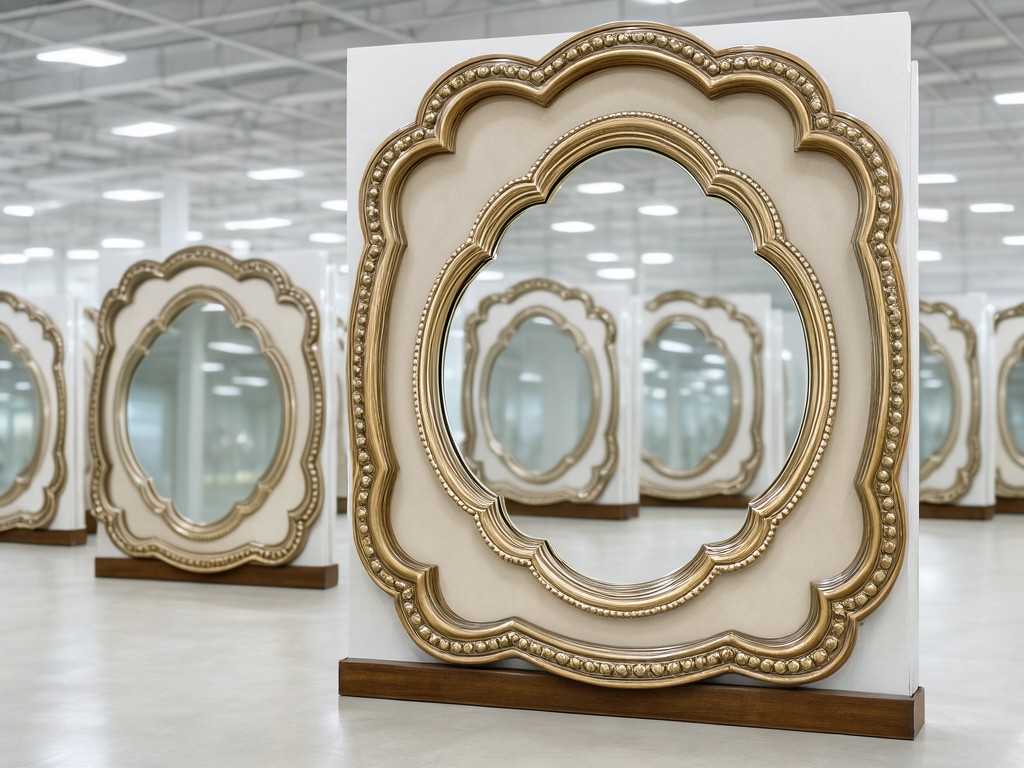
First-article tooling determines the geometric precision of every scalloped curve across the production run. Unlike manual-cut methods where scallops vary in radius, factory-integrated CNC-cutting routers maintain a tolerance of +/- 0.2mm. This precision ensures that the decorative perimeter remains uniform across a 1,000-unit order, which is a critical requirement for retail sets where visual consistency is expected by the consumer.
Process choice shows up later as the structural integrity of the silvering layer. We utilize a 4mm or 5mm float glass base treated with a protective copper-free coating. This specific chemistry prevents the oxidation—visible as black spotting—commonly seen in lower-grade mirrors exposed to coastal air or bathroom environments. By controlling the silvering process in a clean-room environment, the reflective lifespan is extended by approximately five years compared to standard commercial imports.
Consistency is set at the forming stage of the frame-to-glass interface. For scalloped designs, the frame is often injection-molded over a custom profile, ensuring the pressure is distributed evenly around the glass edges. This prevents stress fractures at the sharp points of the scallops, which are the primary cause of glass failure in large-format decorative mirrors.
Where This Product Beats Standard Alternatives
| Feature | Standard Retail-Grade Mirror | Factory-Direct Spec |
|---|---|---|
| Edge Uniformity | Manual variance (+/- 3mm) | CNC-Precision (+/- 0.2mm) |
| Silvering Protection | Standard oxidation-prone | Copper-free protective coating |
| Frame Stability | Thin-walled plastic | Reinforced MDF/Molded Poly |
Matching the Product to the Buyer's Need
Selecting the correct glass thickness depends on the intended installation and weight-budget. For high-turnover retail environments, 4mm glass offers a sufficient balance between cost and weight-optimized shipping. However, for luxury hospitality projects where mirrors serve as focal points, 6mm glass is required to prevent optical distortion across large surface areas and increase impact resistance.
- 4mm Glass: Ideal for residential bedroom decor and weight-sensitive mounting hardware.
- 5mm Glass: The standard for commercial-grade high-traffic zones.
- 6mm Glass: Necessary for oversized architectural installations to ensure a perfectly-flat reflection.
Buying Mistakes That Lead to Returns
The most common failure mode is neglecting the mounting hardware-to-weight ratio. Because scalloped edges reduce the structural surface area of the frame, standard-clip mounts often fail under the load of large mirrors. Buyers should specify heavy-duty D-rings or French-cleat systems that distribute the weight across the frame rather than just the scalloped points.
Another critical oversight is the failure to specify edge-protection packaging. Scalloped mirrors are vulnerable at the curves; if the factory does not use molded-foam inserts that match the perimeter geometry, the breakage rate from edge-cracking can exceed 15% during sea freight shipments. Requiring custom-fit corner-guards and heavy-duty corrugated wrapping is a non-negotiable specification for large-format imports.
Volume Planning and Lead Time
| Parameter | Standard Order (100-500 units) | Bulk Order (1000+ units) |
|---|---|---|
| Production Time | 30-45 days | 60-75 days |
| Customization Options | Standard colors | Custom frame-molding |
| MOQ Flexibility | 50 units | 500 units |







