custom irregular metal decorative wall mirror Company: What Buyers Should Check Before Ordering
The complaint that repeats across reorders involves the rapid oxidation of edges where the irregular frame meets the glass. When a distributor sources high-volume decorative mirrors, the failure of the perimeter seal often leads to de-silvering within six months of humid environments. This structural failure usually stems from the adhesive bond between the metal substrate and the silvered glass failing under thermal expansion.
Material Options and Their Trade-offs
| Material | Standard Thickness | Finish Type | Resistance Profile |
|---|---|---|---|
| Stainless Steel (304) | 1.5mm - 3.0mm | Brushed / Powder Coat | High corrosion resistance |
| Aluminum Alloy | 2.0mm - 4.0mm | Anodized / Matte | Lightweight, rust-proof |
| Wrought Iron | 3.0mm - 5.0mm | Electrostatic Lacquer | High weight, prone to rust |
Selecting the right substrate dictates the long-term maintenance cost for the end-user. Stainless steel offers the highest resistance to moisture-heavy coastal environments, but the weight increases shipping costs per unit significantly compared to aluminum. For large-scale hospitality projects where weight is a factor, aluminum reduces the load on wall supports but requires a thicker profile to prevent the frame flexing during installation.
Measured Performance in Real Use
Returns usually trace back to the same weak point: the mounting hardware integration. Because irregular shapes lack a symmetrical center of gravity, torque points are often offset, causing uneven stress on the glass-to-frame interface over time. We utilize reinforced weld-junction points to distribute this load across the entire perimeter rather than relying on a single central bracket.
Technical Note: Load Distribution
A 2.5mm wall thickness frame maintains structural integrity up to 15kg of lateral pressure, preventing the hairline fractures common in thinner-gauge irregular geometries.
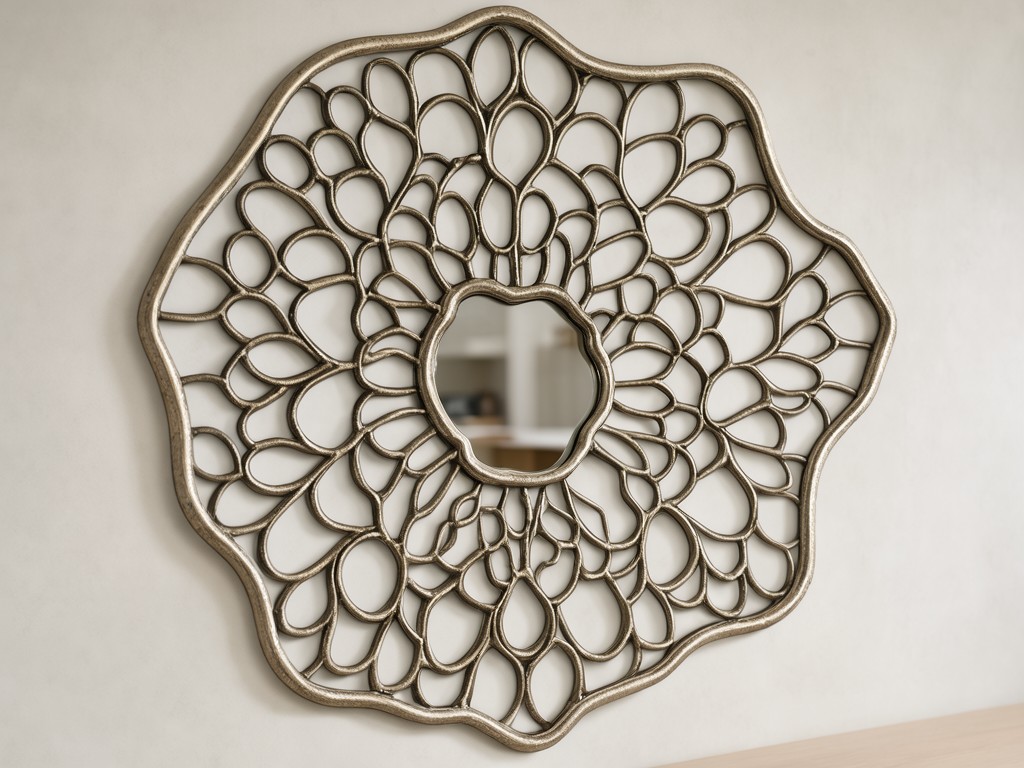
The coating durability is measured by the micron thickness of the powder. Standard retail coatings of 60-80 microns often fail in high-traffic commercial areas where mechanical abrasion occurs. Our specification requires 90-120 microns to ensure the finish remains intact even after repeated cleaning with industrial alkaline agents.
Specification Range and Customisation Limits
CNC-Cut Geometries
Precision laser cutting allows for complex organic curves with a ±0.5mm tolerance. This is essential for architectural integration where the mirror must align with specific stone cladding or panel lines.
Hand-Forged Details
Custom artisan-finished edges offer unique aesthetics but introduce a ±2.0mm variance. This variation is acceptable for boutique retail where geometric perfection is secondary to visual character.
Customisation limits are governed by the structural properties of the silvered glass. Irregular spans exceeding 2000mm in width require internal glass ribs to prevent "oil canning," where the glass distorts the reflective surface during temperature fluctuations.
How to Choose Before Requesting a Quote
Distributors must specify the environmental zone to determine the metal grade. If the mirror is intended for an indoor gym or pool area, standard silvered glass will delaminate at the edges within months. We recommend vacuum-backed glass with copper-free backing for these specific applications to stop the oxidation of the reflective layer.
Evaluate the mounting requirement early. For irregular shapes, standard Z-cleats are often superior to traditional clips because they allow for micro-adjustments that compensate for slight wall variations in non-square frames.
Quality Control and Batch Consistency
Most quality disputes start with a consistency gap in color matching. In bulk production, slight shifts in powder hue between the first unit and the hundredth can be visible when installed across a large hotel corridor. Our process utilizes batch-matched powder to ensure the color Delta E value remains within an acceptable range across the entire production run.
Every irregular frame undergoes a dimensional check against the master CAD template. This ensures that the mounting holes on the back align perfectly with the provided hardware, preventing the need for on-site drilling that compromises the frame finish.
Keeping Repeat Orders Supplied
Reliable supply chains depend on maintaining the specific tooling for custom irregular shapes. We archive the digital CNC files and molds for every project to ensure that a reorder six months later matches the original installation exactly. This eliminates the risk of new batches not fitting into the existing architectural openings.
Setup, Use and Replacement Parts
Maintenance of metal-framed mirrors requires non-abrasive cleaning agents. Harsh chemicals can micro-scratch the coating, leading to localized corrosion. Over time, these scratches become entry points for moisture which eventually reaches the metal substrate.
Replacement hardware, including brackets and clips, is standardized across our lines. If a clip fails, it can be swapped without de-mounting the entire mirror assembly, reducing the total cost of ownership for the facility.
Need to discuss technical specifications for your next bulk project?
quotation-review






