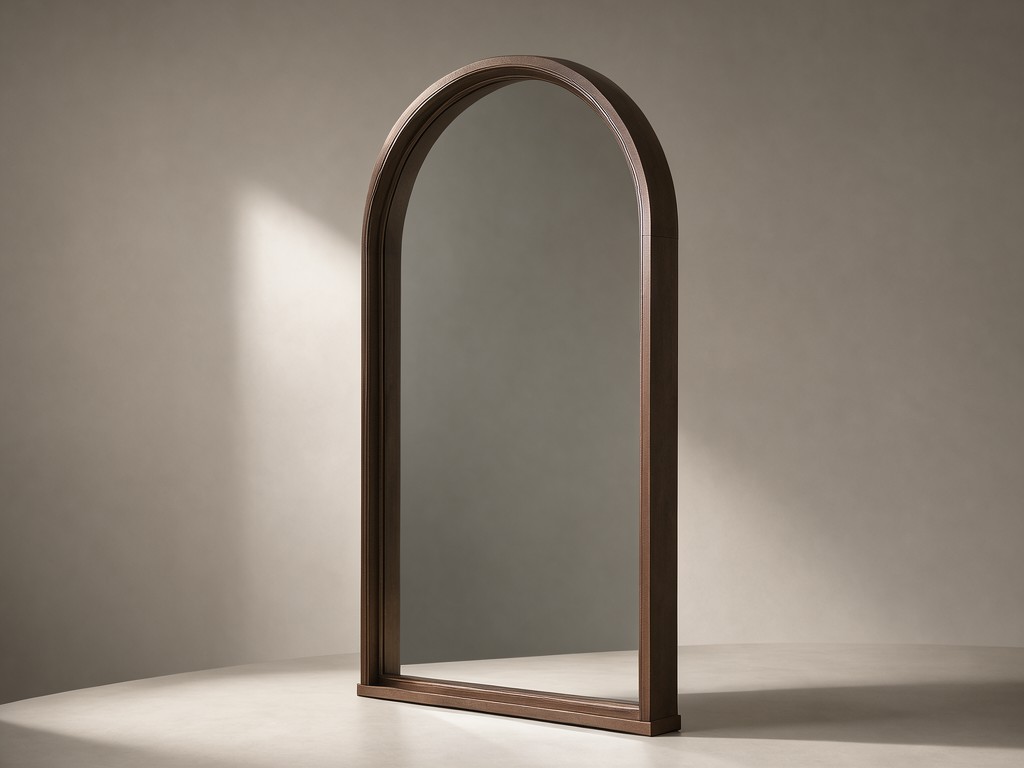
Specifying best price arched floor mirror for sale for Wholesale and OEM Orders
>First-article tooling determines the precision of the arched radius. If the mold offset deviates by more than 0.5mm, subsequent units exhibit frame misalignment at the top-curve, leading to structural gaps in the glass seating. For wholesale procurement, the focus remains on the tolerance levels of the frame-to-glass interface to ensure the oversized panels remain rigid during high-volume transit.
Technical Specification Overview
Oversized arched mirrors typically require a 5mm to 6mm silvered glass thickness to prevent the "funhouse effect" or optical distortion common in thinner-grade large-format retail units.
Scope of Supply and Physical Form
The standard configuration includes the primary arched glass, a structural perimeter frame (typically MDF, extruded aluminum, or solid wood), and a high-density fiberboard backing. For oversized units, the weight-to-surface area ratio dictates the necessity of heavy-duty wall brackets versus free-standing leaning hardware.
- Height ranges typically from 1800mm to 2200mm for full floor applications.
- Widths optimized between 600mm and 1000mm to maintain integrity.
- Frame depths vary from 15mm to 40mm based on impact requirements.
Design Constraints Behind the Specification
Material physics limits the span of the arch without internal structural reinforcement. A wider arch increases the risk of the glass bowing under gravity if the frame material is not sufficiently rigid. To mitigate this, manufacturers utilize a tension-channel design within the frame to distribute the load evenly across the entire perimeter of the arched shape.
The choice of glass coating also impacts the unit price and durability. Standard silvering is susceptible to oxidation in humid environments; moisture-resistant coatings prevent black-edge corrosioning, a critical factor for mirrors intended for bathrooms or high-traffic retail environments.
How It Is Built and What That Changes
The build method decides the frame's resistance to humidity. Extruded aluminum frames offer higher moisture resistance compared to MDF-core alternatives in high-humidity environments where wood-based materials swell and delaminate over time.
Injection Molded Frames
Uses hollow-profile polymers to reduce weight. Best for cost-sensitive retail where extreme impact is a secondary concern to aesthetic warping.
Solid Wood Joinery
Provides high mass and premium tactile feel. Ideal for luxury oversized orders where stability and aesthetic longevity are the primary retail selling points.
Matching the Product to the Buyer's Need
Wholesale buyers must balance shipping costs against breakage rates. A 4mm glass specification reduces unit weight by approximately 20% but increases the probability of fracture during drop-handling. For commercial-grade specifications (hotels, gyms), 6mm tempered glass is the industry standard despite the higher per-unit cost.
Request a technical drawing sheet to review specific dimensional tolerances.
Buying Mistakes That Lead to Returns
The most common cause of returns in oversized mirrors is optical distortion. This occurs when the glass is not perfectly flat against the frame, or when the glass itself has a wavy profile. Buyers who skip the "flatness test" during sample approval often receive units that fail to meet retail visual standards.
Neglecting the backing material also leads to structural failure. Using thin 3mm fiberboard for an oversized span allows the glass to flex, which eventually leads to stress cracks or delamination of the silvered layer.
Customisation Options and Their Limits
Surface finishes are typically limited to powder coating, metallic leafing, or wood veneers. Note that deep-engraved logos on the frame can compromise the structural integrity of thin-walled aluminum profiles, requiring laser-etching instead.
| Parameter | Available Range |
|---|---|
| Glass Thickness | 4mm, 5mm, 6mm (Tempered) |
| Frame Material | Extruded Al, MDF, Solid Oak |
| Arch Radius | Custom (min 300mm radius) |
How Consistency Is Held Across Batches
Process choice shows up later as batch variance in color-silvering hue. To ensure consistency across 1000+ units, we utilize batch-controlled vacuum silvering lines. This prevents the slight tint shifts seen when manual silvering is applied across different production cycles.
Stock Availability and Reorder Planning
Lead times for oversized units are dictated by the glass-cutting capacity and frame-painting drying cycles. A 45-day lead time is standard for custom OEM orders to allow for structural stress testing of the first glass panels produced.
Ready to review our manufacturing capabilities for oversized mirror production?
Initiate tooling review and quote






