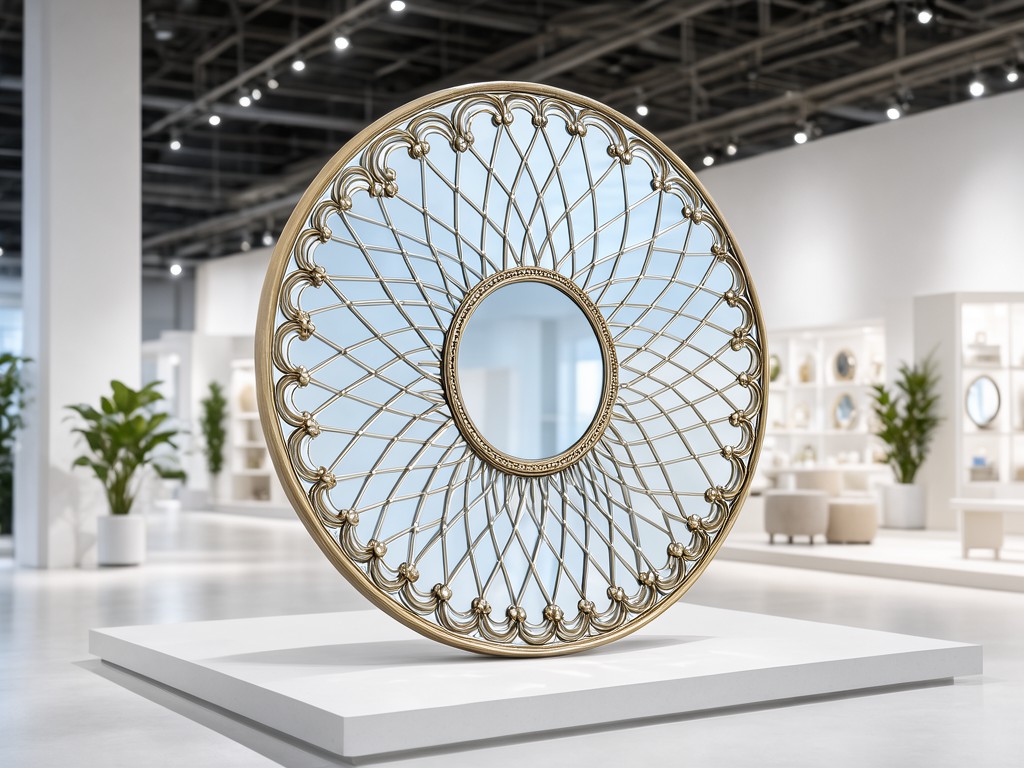
Wholesale Round Decorative Mirrors for Living Room Company: Specification, Ordering and Quality Notes
The build method decides whether a round mirror arrives flat or develops a ripple after six months on a living-room wall. Float glass is cut to diameter, ground and polished at the edge, then silvered and coated with copper-free backing paint before a frame is bonded or mechanically fixed. If the silvering layer is uneven or the backing paint is too thin, moisture migrates to the glass edge and shows as black corrosion within a season. Consistency is set at the forming stage: diameter tolerance, glass thickness and silvering thickness must hold lot to lot, or the buyer fields reorders for size mismatch and edge failure.
Process choice shows up later as weight and freight cost. A 600 mm round mirror in 4 mm glass with an MDF frame typically lands around 4.5-5.5 kg, while the same diameter in 5 mm glass with a solid wood frame can exceed 8 kg. Heavier glass reduces waviness but raises packaging requirements and wall hardware load; lighter glass cuts cost but needs stricter flatness control during silvering. The decision rule is to match glass thickness to frame material and hanging method before quoting, not after samples fail.
Material Options and Their Trade-offs
| Configuration | Glass | Frame | Approx. weight | Edge | Typical use |
|---|---|---|---|---|---|
| 4 mm float glass | 4 mm | MDF, foil-wrapped | 4.5-5.2 kg | Flat polished | Standard living-room hang |
| 5 mm float glass | 5 mm | Solid wood | 7.0-8.5 kg | 25 mm bevel | Heavy decorative piece |
| 4 mm float glass | 4 mm | Aluminium extrusion | 3.8-4.4 kg | Flat polished | Contract and hospitality repeat buys |
Copper-free backing paint costs more than conventional silvering but delays edge corrosion in humid rooms. MDF holds a foil or paint finish tightly but swells if edge-sealed poorly; solid wood adds weight and movement with humidity changes; aluminium stays dimensionally stable but shows scuffs more easily in freight.
Measured Performance in Real Use
Buyers judge these mirrors on flatness, silvering adhesion and wall-load safety. Waviness appears when glass is not annealed evenly after cutting, and it shows up as a distortion effect at 500 mm diameter and above. Silvering adhesion is checked by a cross-cut tape test at the edge; if the coating lifts, black spots follow within months. Wall hardware must carry the mirror weight plus a safety factor, typically rated for at least twice the hanging weight. Lot-to-lot weight drift beyond 5 percent signals glass thickness variation and creates returns when installers pre-drill fixed positions.
Frame joints fail at the mitre when the adhesive is under-cured or the timber moisture content is too high. Backing paint that is too thin chips during handling and exposes the silvering to edge corrosion. Packaging is the last variable: corner protectors and interleaving foam determine whether the mirror reaches the showroom intact or with edge chips that trigger a claim.
How to Choose Before Requesting a Quote
4 mm glass, MDF frame
Lower freight cost and easier wall fixing. Best under 700 mm diameter where waviness stays invisible at normal viewing distance.
Needs edge sealing on MDF to resist humidity swell.
5 mm glass, solid wood frame
Holds flatness at 800 mm and above. Heavier, so wall cleats and fixings must be specified for the full load.
Wood moves with seasonal humidity; allow clearance in the frame rebate.
Customisation Options and Their Limits
Diameter can be adjusted from 400 mm to 1,200 mm in 50 mm increments, but tooling cost rises above 1,000 mm because larger glass sheets carry higher breakage rates. Frame colour and foil wrap are changeable per batch, while frame profile changes require a new mould or extrusion die. Backing print or a private label can be applied to the rear coating, but the ink must not interfere with silvering adhesion or the wall-mount adhesive bond.
Limit: wall cleats are rated for mirrors up to 10 kg. Heavier units need a French cleat or direct stud fixing specified at quote stage.
Artwork for rear branding must be vector format, single colour, and sized to the backing area, not the glass diameter.
Who Uses It and Where It Matters
- Furniture retailers sourcing living-room ranges for seasonal resets.
- Hospitality fit-out contractors installing guest rooms and corridors.
- Interior design practices specifying private-label mirrors for contract projects.
- Wholesale distributors holding stock for trade customers.
Each user group has a different failure tolerance. Retailers reject edge chips visible on the showroom floor; hospitality buyers care about cleaning-chemical resistance and wall security; design contracts need batch-to-batch colour matching across multiple rooms.
Segment-Specific Requirements
Private-label buyers require batch traceability on every carton, with a date code and lot number that matches the sample approval. Export packaging must survive pallet stacking and sea freight without edge contact between units. Retail labelling, where required, goes on the backing or packaging, never on the glass face.
- Sample approval before first production lot, signed off on diameter, edge finish and frame colour.
- Warranty terms set in writing, usually covering silvering adhesion and frame joint failure for a fixed period.
- Reorder lead time depends on glass thickness and frame profile availability.
Keeping Repeat Orders Supplied
Stock availability hinges on glass thickness and frame profile. Four-millimetre float glass and standard MDF profiles are usually held in production, while five-millimetre glass and custom wood mouldings run to order. Lot-to-lot consistency in diameter, weight and finish prevents the size drift that forces installers to re-drill walls and generates returns.
Cost-efficiency comes from holding common diameters and frame colours in stock, then cutting only the glass to order.
Serviceability means replacing a single damaged unit from the same lot rather than re-shooting the whole room.
Ordering, Tooling and Lead-Time Questions
What is the minimum order quantity?
MOQ typically starts at 50 pieces per diameter and frame combination, with lower quantities possible at a higher unit price.
How long is lead time?
Standard configurations ship in 15-25 working days after sample approval; custom frames add tooling time.
Can artwork be applied to the mirror backing?
Yes, single-colour vector artwork prints to the rear coating without affecting silvering adhesion.
Send artwork and brand guidelines for a review before the first sample run.
Artwork and branding review






