Wholesale Glass Rhinestone Decorative Mirror Company: What Buyers Should Check Before Ordering
Repeat loading drives the failure of decorative mirror assemblies when they are subjected to rapid temperature fluctuations. The adhesive interface between the glass rhinestones and the mirror surface often undergoes mechanical shear stress, leading to rhinestone shedding over time cycles. Wholesale buyers frequently overlook the thermal expansion coefficient mismatch between the decorative elements and the substrate, which results in bond failure in environments with inconsistent climate control.
Silvering oxidation at the edges remains a primary cause for returns in high-humidity markets. If the protective coating on the mirror backing is inconsistent, moisture penetrates the silver layer, causing dark spots that compromise visual clarity. This chemical degradation is accelerated by the thickness of the backing paint and the quality of the edge-seal applied during the manufacturing process. Ensuring a high-density moisture barrier extends the longevity of the reflective surface in diverse retail environments.
What Actually Determines Performance
The limiting factor is rarely the headline specification of glass thickness
Performance depends on the tensile strength of the adhesive bond and the UV stability of the rhinestone coating. A 4mm substrate provides better structural rigidity than 3mm glass but increases the weight per-unit shipping cost for bulk distributors. Buyers must balance the required structural integrity against the freight-related budget of the specific end-user.
Material Options and Their Trade-offs
| Component | Specification | Performance Trade-off |
|---|---|---|
| Adhesive | UV-curable epoxy | Rapid set time; requires specialized curing equipment. |
| Rhinestone | Soda-lime glass | High refractive index; higher weight than plastic. |
| Mirror Substrate | Tempered glass | High impact resistance; higher manufacturing cost per unit. |
Measured Performance in Real Use
Fatigue appears at the stress concentration where the frame meets the glass surface. In high-traffic retail environments, constant vibrations from shelf handling can loosen rhinestones if the mechanical fastening is not utilized alongside the adhesive. Using a secondary mechanical clip for the decorative elements reduces the risk of catastrophic aesthetic loss but increases the assembly time per unit. This trade-off is critical for distributors targeting high-durability commercial contracts.
Specification Range and Customisation Limits
Standard Production
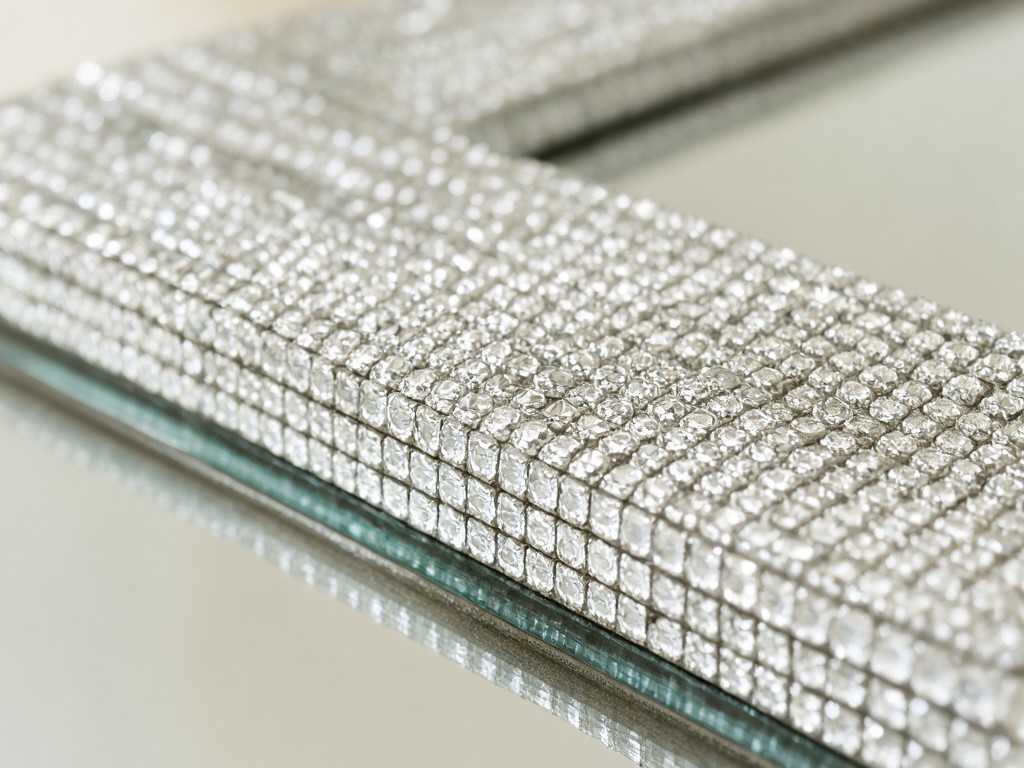
Standard sizes utilize pre-cut dies, allowing for lead times of 14-21 days for bulk orders. Rhinestone patterns are limited to established geometric layouts.
Custom Orders
Custom geometries require CNC glass cutting and bespoke tooling. Tooling amortisation necessitates a minimum order of 500 units to maintain competitive pricing.
Requirements by Buyer Segment
Distributors prioritize pallet-level consistency and standardized packaging dimensions to minimize logistics costs. Private-label manufacturers focus on the specific rhinestone geometries and custom frame finishes that align with seasonal interior trends. Procurement officers for hospitality chains require rigorous batch traceability to ensure material consistency across large-scale rollouts.
Inspection Items and Test Methods
| Test Method | Objective |
|---|---|
| Cross-hatch Adhesion | Evaluate rhinestone-to-glass bond strength. |
| Salt Spray Exposure | Assess silvering resistance to environmental humidity. |
| Impact Drop | Determine glass fracture threshold during transit. |
Keeping Repeat Orders Supplied
Maintaining a supply chain depends on the amortisation of tooling for custom mirror shapes. When a buyer places high-volume orders, the per-unit cost of the die-cutting process is distributed across larger batches. Consistency in material sourcing ensures that the refractive index of the glass elements remains uniform across different production runs.
Export Packaging and Handling Protection
High-density foam inserts and reinforced corrugated crates are necessary to prevent micro-fractures in the glass during maritime transit. Standardized palletization ensures that the rhinestones do not shift and abrade against each other during sea-air vibrations.







