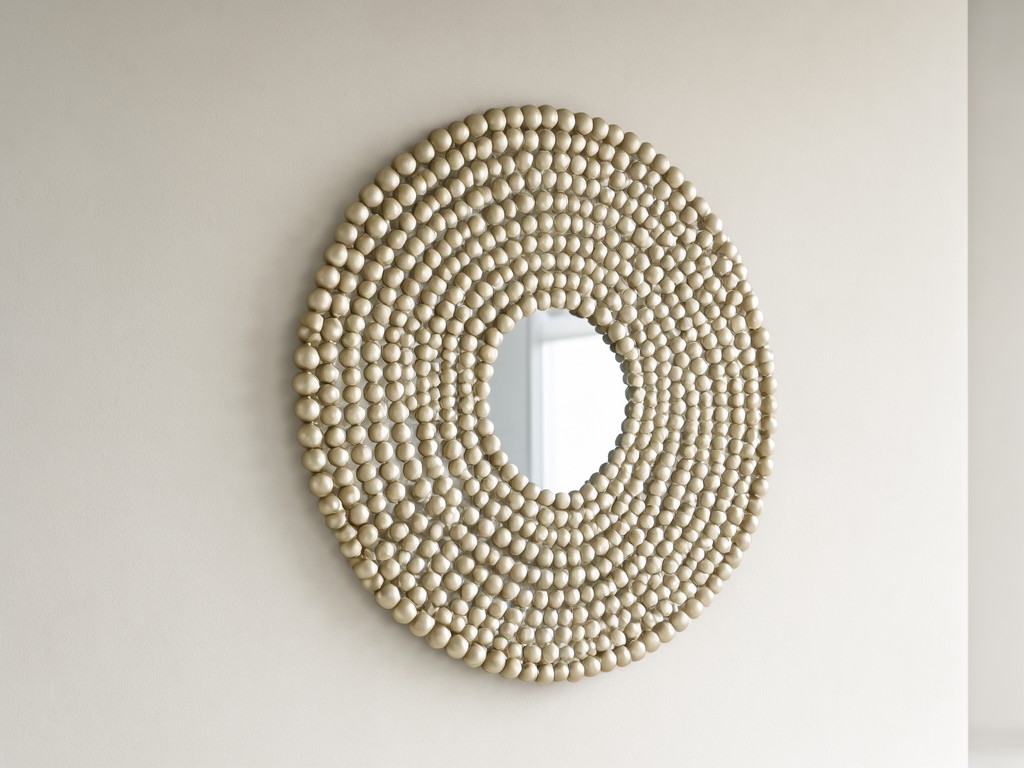
custom ball bead decorative accent wall mirror Company: Specification, Ordering and Quality Notes
Construction Method and Its Effect on Consistency
The structural bond between the mirror substrate and the ball bead assembly determines long-term mechanical integrity. Mechanical fastening offers higher resistance to shear forces but may limit design flexibility for curved bead patterns. Adhesive bonding allows for complex geometries but requires precise humidity control during curing to prevent bead shifting or adhesive-creep. We utilize industrial-grade cyanoacrylate or UV-cured resins to ensure the silverreflective interface remains stable through thermal expansion cycles.
Size, Weight and Specification Range
| Parameter | Standard Range | Tolerance |
|---|---|---|
| Mirror Diameter (mm) | 400 - 2400mm | ±2mm |
| Glass Thickness (mm) | 4mm, 5mm, 6mm | ±0.2mm |
| Bead Diameter (mm) | 8mm - 25mm | ±0.5mm |
| Total Weight (kg) | 2.5kg - 18kg | ±5% |
How to Choose Before Requesting a Quote
Material choice starts with the conditions the product will meet. High-humidity environments demand glass beads or treated polymers over natural wood to prevent rot or dimensional expansion. For indoor-only applications, lightweight resins reduce freight costs significantly without compromising aesthetic density. The silvering coating of the mirror must be matched to the environment; copper-free silvering is required for coastal regions to prevent oxidation and black spotting.
OEM and ODM Programme Structure
ODM (Standard Catalog)
Utilizes existing frame molds and standard bead sizes. This path minimizes lead times and eliminates tooling fees for buyers with limited capital or specific retail needs.
OEM (Custom Specification)
Requires custom CNC-cut bead patterns and bespoke frame profiles. Involves a technical drawing phase to confirm tolerances and alignment with specific architectural requirements.
How Consistency Is Held Across Batches
Batch-to-batch variance often occurs in the silvering temperature and bead pigment consistency. We utilize spectrophotometer-verified glass batches to ensure the reflective index remains constant across production runs. Color matching for dyed beads is managed through Delta-E standards to prevent visible shifts between separate orders of the same SKU.
Packing, Marking and Freight Configuration
| Protection Layer | Material | Function |
|---|---|---|
| Primary Surface | Anti-static foam film | Prevents surface scratches |
| Corner Buffer | EPS-corrugated foam edges | Absorbs impact energy |
| Outer Casing | Double-wall corrugated | Structural load-bearing |
Setup, Use and Replacement Parts
Maintenance and Hardware
Mounting requires French-D-ring brackets to prevent stress fractures on the glass edges. Cleaning protocols must specify non-abrasive agents with neutral pH to avoid chemical degradation of the silvered layer. Individual ball beads are available for replacement if mechanical failure occurs during high-impact installation.
Ordering, Tooling and Lead-Time Questions
Tooling costs apply only when custom bead molds or non-standard frame profiles are requested. Lead times for wholesale orders range from 30 to 45 days, whereas OEM projects require an additional 21 days for mold validation and sampling. Final approval of a physical gold sample is mandatory to ensure dimensional alignment with technical specifications.
Frequently Asked Questions
- What is the MOQ for custom bead colors? The minimum is typically 500 units per SKU to cover pigment dye-batching costs.
- Are the mirrors UV-resistant? Standard silvering is not; UV-protective film can be laminated for environments with direct sunlight exposure.
- Can we receive a technical drawing? Yes, we provide CAD files detailing all tolerances and bead placement points during the design phase.
Ready to initiate a production schedule for your retail line? Review our quotation and technical specifications today.