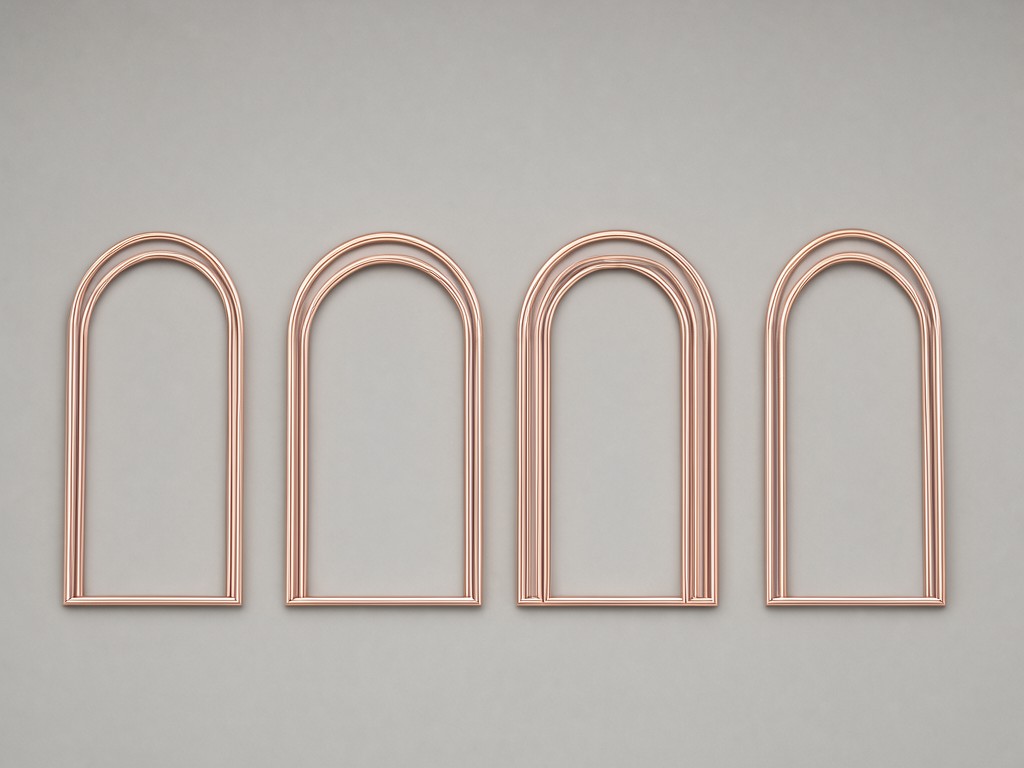
wholesale rose gold arch wall mirrors supplier: Specification, Ordering and Quality Notes
Finish consistency drives the unit price more than glass thickness. A 0.8–1.2 µm electroplated rose gold layer on steel holds indoor humidity but can drift 3–5 % in tint across a 500-piece lot if the plating bath chemistry is not controlled. PVD coating adds roughly 15–25 % to the frame cost and keeps the arch within ±2 % of the approved swatch across the same lot. Specify electroplating when you are replenishing a catalogue line and can absorb a small shade variance; specify PVD when the mirror must match an existing retail fit-out exactly.
Scope of Supply and Physical Form
Black edge corrosion appears first at the bottom of the glass where moisture collects, then spreads under the reflective coating until the mirror surface fails.
The supply unit consists of float glass, a reflective silver or aluminium layer, a protective backing paint, a rose gold arch frame, and wall hardware. Glass is typically 3 mm or 4 mm thick; 5 mm is available for large arch formats but adds roughly 2.5 kg per square metre and changes the wall fixing specification. The arch frame is usually steel, aluminium, or MDF wrapped in a rose gold foil, with the glass retained by clips or a shallow rebate. Weight consistency matters because a 10 % frame-weight drift changes the load rating on the wall cleat and can generate returns from retail buyers who test fixings before shelving.
How It Performs in Use
Deflection under load governs whether an arch mirror stays flat on the wall or develops a visible bow over time. A 4 mm glass panel in a 900 mm arch span will deflect less than 1 mm under its own weight if the frame provides continuous support around the perimeter; point-fixed glass without that support can sag enough to distort reflections at eye level.
The reflective coating must also survive cleaning with standard glass detergents without pitting, and the backing must resist humidity cycles in bathrooms and hotel corridors where the product is usually installed. Performance is judged on reflection clarity, flatness within a stated tolerance, frame adhesion to the glass, and colour retention of the rose gold finish. The frame is bonded to the glass with a structural adhesive or held by mechanical clips; adhesive bond failure shows as rattling in transport and separation at the arch crown after twelve to eighteen months on the wall. Mechanical clips add visible fasteners but eliminate bond-creep. Each choice trades installation speed against long-term service appearance.
Option Comparison by Usage Level
| Frame option | Substrate | Finish | Coating thickness | Lot shade variance | Unit weight | Best suited to |
|---|---|---|---|---|---|---|
| Electroplated rose gold | Steel | Electroplating | 0.8–1.2 µm | ±3 % | 4.2–4.8 kg | Catalogue replenishment |
| PVD rose gold | Aluminium | PVD coating | 1.5–2.5 µm | ±2 % | 2.8–3.4 kg | Retail fit-out matching |
| Powder-coated rose gold | MDF | Powder coat | 40–60 µm | ±5 % | 3.6–4.2 kg | Low-cost display |
Electroplated steel is the default for replenishment orders because the tooling is already in place and the cost per arch is lowest, but the buyer must accept a shade band of roughly ±3 % between production runs. PVD aluminium costs more up front and removes most of that variance, which justifies the price when the mirror is specified against an existing retail fit-out. Powder-coated MDF is the cheapest option but chips at the mitred corners and is not suitable for high-humidity rooms.
Requirements by Buyer Segment
Private-label buyers need a pre-approved sample sealed against the production batch so the frame colour does not drift between the first order and the reorder. They also need batch codes on the packaging so a defective lot can be isolated without recalling the entire container.
Importers prioritise export packaging that protects the arch corners and the glass edges, since corner damage is the most frequent claim after sea freight. They also need consolidated documentation for customs classification and a declared weight per carton that matches the actual packed weight within 2 %.
Retail buyers focus on shelf-ready presentation and wall-fixing safety, requiring the mirror to hang level within one degree and the D-rings or cleat to be positioned symmetrically on the back.
Working as a Production Partner, Not a Catalogue Supplier
Sample approval is the point where most private-label orders fail. The factory should send a physical arch mirror from the actual plating line, not a photograph, and the buyer should approve the glass thickness, frame finish, backing type, and carton specification before tooling is confirmed. Once approved, batch traceability records link each production run to the plating bath, the glass supplier lot, and the adhesive batch so any field failure can be traced to its source.
OEM and ODM orders run on minimum order quantities that depend on the frame substrate. Steel arches can start at 100–200 pieces because the frame die is standard; aluminium PVD frames usually require 300–500 pieces to justify the coating line setup; MDF frames with custom foil wrapping can go lower but carry higher per-unit tooling amortisation. Lead times run four to eight weeks after sample approval, longer during peak export seasons when air freight space for fragile goods is constrained.
Branding and artwork requirements include frame logo embossing, backing label placement, and retail carton printing. The buyer supplies vector artwork and approves a pre-production proof; changing the artwork after the printing plates are made incurs a full re-plate charge.
Inspection Items and Test Methods
Dimensional checks cover the arch height, width, frame thickness, and glass squareness, usually with a tolerance of ±1 mm on the overall size and ±0.5 mm on the frame rebate. Weight is checked per carton to detect missing hardware or incorrect glass thickness. Coating adhesion is tested with a cross-hatch tape test on the frame finish and a scratch test on the reflective backing; both must pass before the lot is released.
Reflection clarity is inspected under 500 lux daylight-balanced lighting with the mirror held at a one-metre distance; any pinhole, black spot, or distortion visible at that distance is a reject. Packaging is drop-tested from the height stated in the export specification, typically 750 mm on the corner, to confirm the corner protectors and foam inserts survive a standard handling drop. Batch codes and carton weights are recorded on the inspection report and retained for at least twelve months.
Stock Availability and Reorder Planning
Stock availability depends on the finish.
Electroplated steel arches in standard sizes are often held as semi-finished components and can be packed within two weeks of order confirmation. PVD aluminium and custom foil-wrapped MDF are made to order and require the full production lead time.
Reorder planning should use the previous lot's shade measurement as the baseline; if the new batch measures outside ±2 % of the approved swatch, the plating line must be adjusted before the full quantity is released.
Safety stock should cover one sales cycle plus the production lead time, because a stockout on a private-label mirror programme usually forces the buyer to redesign the display wall or delay the store opening. Reorder triggers are set at 40 % of the safety stock level, and the factory should confirm plating bath readiness two weeks before the expected purchase order.
Need a specification review for your rose gold arch mirror programme? Send your technical requirements and we will confirm frame options, glass thickness, lot tolerance, and lead time before you commit to tooling.







