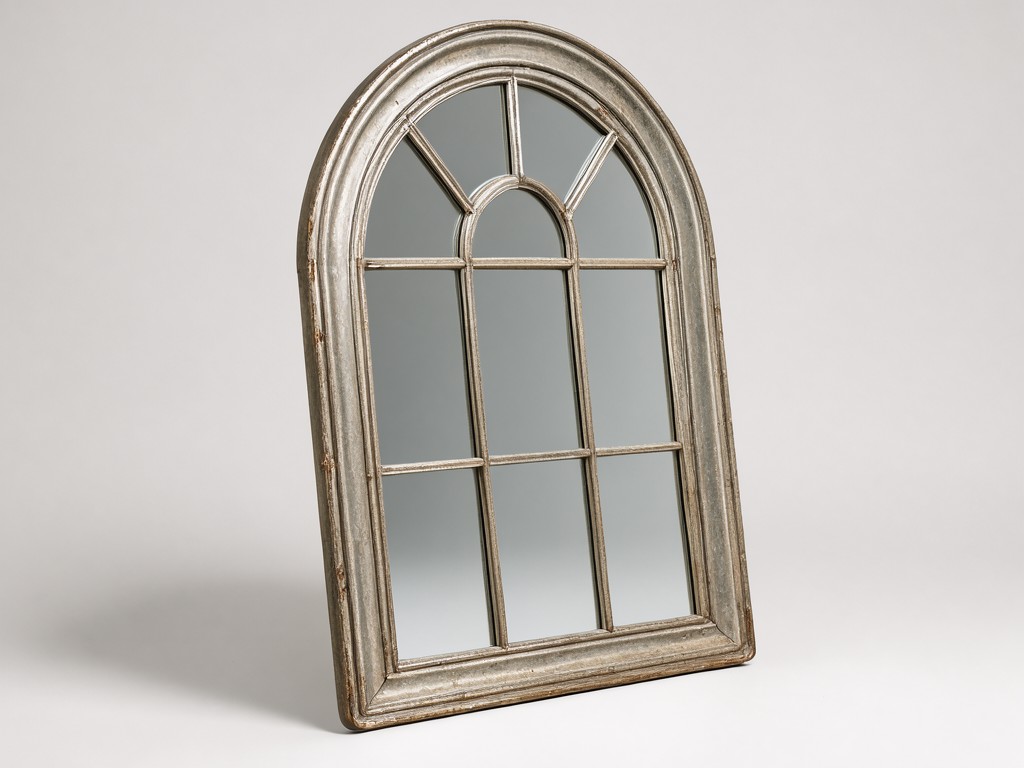
odm vintage arched wall mirror exporter: Specification, Ordering and Quality Notes
A vintage arched wall mirror is specified by glass thickness, frame construction, and edge sealing before a single unit enters the export carton. Buyers sourcing through an ODM exporter usually discover that the arched crown is not just a styling choice—it changes how stress distributes across the glass and how the frame must be joined to prevent seasonal movement.
How It Performs in Use
In a hallway or above a console, the mirror carries its own weight on two or three hangers while the arched top concentrates flex at the crown. The most common field complaint is not glass breakage but silvering failure at the edges, where moisture migrates behind the coating and forms black spots within 12 to 24 months in humid rooms.
Serviceability depends on whether the backboard is sealed and whether the frame allows access to the hanging hardware without dismantling the moulding. A screwed timber backboard can be reopened to replace a failed hanger; a glued MDF backboard usually cannot, which shortens the expected service life from eight to ten years down to three to five.
Glass
4 mm or 5 mm silvered float glass; copper-free option available
Frame
MDF with antique paint finish or solid pine with distressed stain
Size range
600–1200 mm high; 400–800 mm wide
Weight
6–18 kg depending on size and glass thickness
Hanging
D-ring and wire or sawtooth hanger rated to frame weight
Packaging
Foam corners, 5-ply carton, palletised for LCL or FCL
The arched crown adds roughly 15 to 25 mm of height over a rectangular equivalent and requires a slightly wider frame profile to resist racking during transit.
Assumptions Buyers Should Stop Making
Buyers often treat an arched mirror as a flat rectangle with a curved top, which leads to ordering hangers rated for the glass weight alone. In reality, the frame must carry the dead load plus the dynamic load of wall vibration, and the arch creates a leverage point at the shoulders where the curve meets the vertical sides.
Another assumption is that a distressed vintage finish masks frame defects. It does not; it makes edge chipping and joint separation harder to see at incoming inspection but more visible under retail lighting after six months.
Solid Wood Frame
Holds screw threads for hangers and tolerates rework, but moves with humidity and costs more per kilogram.
MDF Frame
Dimensionally stable and cheaper to paint, but screw pull-out is weak and the backboard is usually glued shut.
Quality Control and Batch Consistency
Consistency is set at the forming stage. Silvering thickness varies across a batch if the deposition line is not calibrated, so one mirror may resist edge corrosion while its neighbour shows blackening after one rainy season in a warehouse.
Frame moisture content is the second variable. Timber above 12 percent equilibrium moisture content will shrink and open mitre joints in air-conditioned retail spaces.
Specification rule: agree silvering thickness (typically 8–12 nm) and frame moisture content (8–12 percent) on the pre-production sample, not in the purchase order.
Batch consistency is checked by pulling three units per lot from different positions in the production run. If the variation in glass flatness exceeds 0.5 mm over a 600 mm span, the lot is held.
Inspection Items and Test Methods
Incoming inspection focuses on the failure modes that appear after installation, not on how the mirror looks in the factory under bright light. Edge corrosion, hanger pull-out, and carton corner damage are the three issues that generate claims.
| Size Code | Height (mm) | Width (mm) | Glass (mm) | Frame Depth (mm) | Approx. Weight (kg) | Hanger Rating (kg) |
|---|---|---|---|---|---|---|
| VAM-60 | 600 | 400 | 4 | 25 | 6 | 10 |
| VAM-80 | 800 | 500 | 4 | 25 | 9 | 12 |
| VAM-100 | 1000 | 600 | 5 | 30 | 13 | 15 |
| VAM-120 | 1200 | 800 | 5 | 30 | 18 | 20 |
- Dimensional tolerance holds ±2 mm on height and width, with arch radius ±3 mm.
- Glass distortion is viewed at 1 m; a straight edge must not deviate more than 1 mm.
- Silvering edge seal is accepted only if no black spots appear after 48-hour humidity exposure at 40 °C.
- Frame joint gap is inspected under 10× magnification for visible separation at the mitres.
- Hanger pull test holds the rated load for 60 seconds without detachment.
- Packaging drop test uses one corner drop from 600 mm with no glass fracture permitted.
Test methods are factory-side checks; they are not certifications and do not replace third-party lab reports if your market requires them.
Ordering, Tooling and Lead-Time Questions
First-article tooling determines whether the arched moulding matches the approved sample across a 500-piece order. The frame profile, the arch radius, and the paint distress pattern must be signed off on a physical sample before tooling is cut; photo approvals are not sufficient for vintage finishes because colour shift between batches is common.
Lead time is driven by glass cutting and silvering lead time, not by frame assembly. For a first order, allow 35 to 45 days from sample approval to ex-works; repeat orders typically run 25 to 30 days.
Frequently Asked Ordering Questions
- What artwork is needed for the vintage finish? A signed-off finish sample or colour reference plus a photograph of the target distress pattern; we cannot match “vintage” from a description alone.
- Can I change the arch height after tooling? No. The arch radius is cut into the moulding knife; changing it requires a new tool and a new sample cycle.
- What is the MOQ? Typically 100 pieces per size for ODM; smaller quantities are possible at ex-works pricing with a carton surcharge.
- How are mirrors packed for export? Foam corner guards, interlayer paper, 5-ply carton, six units per master carton; palletised for FCL.
- What is the sample approval process? Pre-production sample sent for dimensional and finish approval; production starts after written sign-off.
Artwork and Branding Review
Send your finish sample, label artwork, and carton marking requirements before production is scheduled. We review tolerances, silvering specification, and packaging configuration to prevent shipping delays.
Request artwork and branding review






