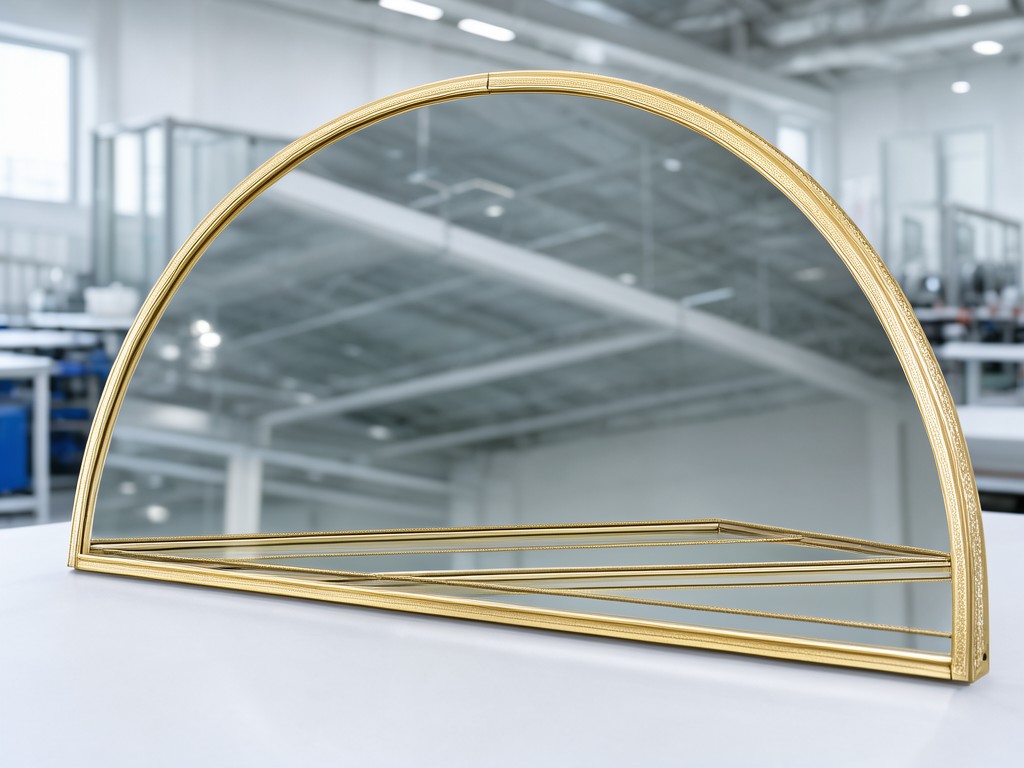
Specifying factory direct arched gold wall mirror exporter for Wholesale and OEM Orders
The Problem Buyers Keep Paying For
| Freight failure mode | What reaches the buyer | Specification control |
|---|---|---|
| Corner impact on arch crown | Glass chips at the radius, frame mitre opens | 3 mm minimum glass at crown, corner protectors, six-side foam |
| Moisture trapped in carton | Silver backing develops black edge at the perimeter | Copper-free silvering, sealed backboard, desiccant in master carton |
| Frame finish abrasion | Gold foil scuffs against neighbouring cartons | Interleaving paper, frame wrap, master carton edge guards |
| Carton stack collapse | Mirror shifts, hanging hardware punches glass | Pallet configuration, maximum stack height printed on carton |
Buyers pay twice: once for the unit, again for replacement freight and lost shelf time.
Cost and durability pull in opposite directions once a buyer specifies thin glass to hit a price point. The arch crown concentrates impact energy, so a 3 mm crown chips where a 5 mm crown absorbs the same blow. Thicker glass raises carton weight and freight cost, but it removes the most common damage claim in export shipping. The choice is therefore a freight-versus-replacement calculation, not a material preference.
Packaging decisions follow the same logic. A mirror that survives the factory line can still fail in a mixed pallet if corner protectors are omitted or if cartons are stacked beyond their compression limit. Buyers who specify the lowest carton grade usually reorder glass, not mirrors.
How It Performs in Use
Material choice starts with the conditions the product will meet.
A gold finish tells the buyer almost nothing about the substrate beneath it. MDF moves with humidity and can telegraph swelling through the gold layer at the arch joint; solid wood holds its shape but adds weight and cost; aluminium resists corrosion but rarely takes a convincing gold tone without a paint system that can chip. Glass flatness matters more than colour: a wavy sheet distorts the reflection at the crown and draws complaints even when the silvering is perfect.
| Service condition | Typical failure mode | Specification response | Field service expectation |
|---|---|---|---|
| Bathroom or high humidity | Silver black edge, backboard delamination | Copper-free silver, sealed MDF, ventilation gap | Typically 3-7 years depending on ventilation |
| Gym or sweat splash | Frame coating softens, silver spot corrosion | Sealed frame, copper-free backing | Usually 2-5 years depending on cleaning regime |
| Direct sun or sunroom | Silvering haze, frame finish fade | UV-stable topcoat, indirect siting | Often 2-4 years with UV exposure |
| Dry retail or hotel corridor | Frame finish scuff, glass distortion under heat | Standard silver, paint or foil finish | Typically 5-10 years |
The backing system determines how long the reflection stays uniform. Conventional silver can develop black edge when moisture reaches the perimeter; copper-free silver resists that migration but costs more per square metre. A sealed backboard slows moisture ingress, while an unsealed board traps condensation against the silver in a bathroom fit-out.
Specification rule: match hanging hardware to the actual mirror weight plus a margin, not to the appearance of the frame. A gold-painted MDF frame can look substantial while carrying a glass weight that pulls a small D-ring out of the substrate.
Size, Weight and Specification Range
Arched mirrors are sold by finished dimension, glass thickness and frame build, not by a single catalogue size. Typical glass thickness runs 3 mm to 5 mm; arch rise usually falls between 150 mm and 300 mm above the rectangle; frame width ranges from 20 mm to 60 mm depending on the substrate. Finished weight lands around 8 kg to 15 kg per square metre, which drives both the hanging hardware rating and the master carton weight limit.
Export / humidity build
4 mm glass
Copper-free silver
MDF frame, gold paint
Sealed backboard
Suited to bathrooms and covered outdoor areas
Display / dry interior build
3 mm glass
Conventional silver
Solid wood frame, gold leaf
Standard backboard
Suited to dry interiors and retail walls
Custom arch radii and frame widths change the tooling cost, while standard radii keep the unit price down. Process capability shows up in radius consistency: a press or mould that holds the same arch across a batch prevents one mirror from sitting proud of the next on a retail wall. Buyers should specify the exact radius in the purchase order because “arched” is not a dimension; two suppliers can interpret the same drawing differently.
Assumptions Buyers Should Stop Making
Where chlorine, sweat or UV exposure is routine, a gold tone is not automatically corrosion-proof.
The most expensive assumption is that the sample represents the production run. A hand-finished sample can use real leaf while the production batch uses paint or foil over MDF; the colour matches at first glance but the wear rate does not. Another common error is treating the arch radius as cosmetic when it actually sets the fracture point under impact. Buyers also assume all mirrors use the same silvering, yet bathroom and retail environments demand different backing specifications.
- Gold colour does not indicate leaf; most export units use paint or foil over MDF, and the difference shows in chip resistance.
- Arch radius is a structural specification, not a styling note; it determines where impact cracks start.
- Silvering varies by environment; conventional silver fails at the perimeter in humid rooms, while copper-free silver costs more but resists black edge.
- A sample approval without batch traceability means the reorder can arrive with a different substrate and finish.
Inspection Items and Test Methods
Do not release a lot on visual check alone; an arched mirror can hang straight and still show convex distortion at the crown.
Inspection starts at dimension: width, height and arch rise checked against the order, typically within ±2 mm. A reflection-line test across the crown catches glass distortion that a flat centre hides. Silver adhesion is verified at the edge with a tape lift; any lifting means the backing will fail in service. Each master carton gets a corner drop and a flat-face drop, and carton weight is verified against the packing list so missing hardware or backing board is caught before shipment.
Batch traceability labels are matched to the approved sample before release, and the reorder specification is locked to the same glass thickness, silvering type and frame substrate. Without that lock, a second production run can look identical on the wall and behave differently in freight.
Project Discussion
Send your specification sheet, target price and annual volume to open a sample approval run. We pack to pallet configuration and provide batch traceability on every reorder.
Start a project discussion






