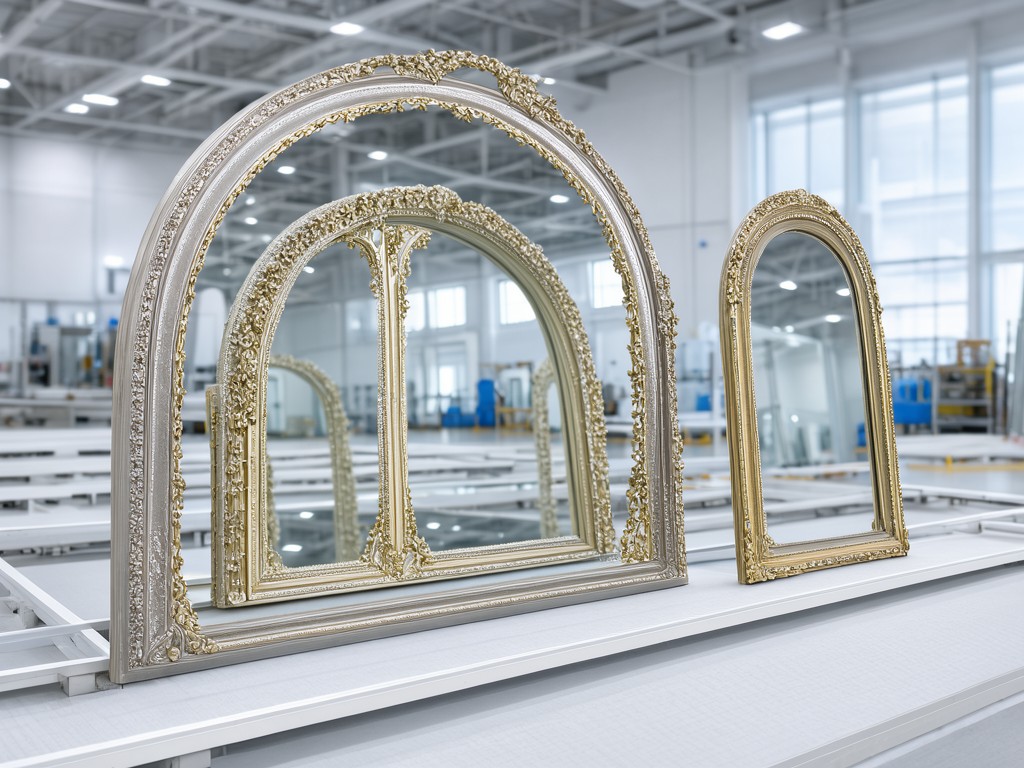
Specifying direct factory very large arched wall mirror exporter for Wholesale and OEM Orders
During a private-label launch with a fixed ship date, mirror orders often fail at the receiving dock, not at the sample stage. A very large arched wall mirror is judged by glass thickness, edge finish, arch radius tolerance, and how it survives export crating. Buyers who match a private-label specification without redesigning the product need to know which variables are fixed by the factory's tooling and which can be changed for each order.
The Problem Buyers Keep Paying For
Moving from sample orders to container loads changes the failure pattern. The most common complaints are silver spoilage at the cut edge, chipped corners after domestic delivery, and an arch radius that leaves an uneven reveal against the wall. A thinner glass sheet cuts freight cost but bows under its own weight above 900 mm in height, while a thicker sheet raises the unit price and the load rating required of the wall fixing.
- Edge desilvering appears within months when the silver coating is not sealed at the cut perimeter.
- Corner damage tracks directly to crate design and whether corner protectors are used.
- Arch radius deviation of even 5 mm is visible at the wall line in a hallway or bathroom.
- Weight variance between pieces in the same batch complicates mounting specifications for retail fixtures.
Design Constraints Behind the Specification
Float glass is cut to an arch template, ground and polished at the edge, then silvered and coated with a safety backing film. Framed versions add an aluminum extrusion or wood frame mitered at the arch; frameless versions rely entirely on the edge finish for appearance and strength. The tooling that matters most is the arch template and, for framed models, the frame die or miter setup.
Key parameters
4 mm, 5 mm, 6 mm
Copper-free silvering
Seamed, polished, beveled
PET safety film optional
±3 mm radius
Template cost is fixed per arch radius. A standard radius is already in stock; a custom radius adds tooling time and extends the first-order lead time. That fixed cost is amortised across the order quantity, so unit price falls as volume rises.
Matching the Product to the Buyer's Need
When a brand extends an existing range, the mirror must match the current range's edge profile and glass thickness or the mismatch shows at retail. Retail buyers select by usage condition. A bathroom mirror faces humidity and needs a sealed silver edge; a gym or dance studio mirror faces impact and needs thicker glass with a safety backing film; a hallway mirror is mainly judged on weight and wall fixing. The wrong combination either breaks in transit or fails at the wall.
Performance reference
| Specification | Glass thickness | Edge finish | Backing film | Typical weight per m² | Best suited to |
|---|---|---|---|---|---|
| Frameless arched mirror | 4 mm | Seamed edge | None | Approx. 10 kg | Decorative wall, low-traffic area |
| Polished-edge arched mirror | 5 mm | Polished edge | PET safety film | Approx. 12.5 kg | Bathroom, hallway, retail fitting room |
| Beveled framed arched mirror | 6 mm | Beveled edge, aluminum frame | PET safety film | Approx. 15 kg | Hospitality lobby, studio, high-traffic wall |
What Can Be Customised and What Cannot
Dimensions, arch radius, glass thickness, edge finish, frame colour, backing film, and carton labelling can be changed without new tooling when the radius already exists in the template library. What cannot be changed without new tooling is a non-standard arch radius, tempered glass in an arched shape beyond the furnace's size limit, or a frame profile that requires a new extrusion die.
A custom arch radius requires a new cutting template. The template cost is charged once and amortised over the order; it is not repeated on reorders.
Finish and colour matrix
| Option | Choices | Tooling impact | MOQ impact |
|---|---|---|---|
| Glass tint | Clear, low-iron, grey, bronze | None | None |
| Frame finish | Silver anodized, matte black, brushed gold, wood veneer | Existing die only | None for stock finishes |
| Edge finish | Seamed, polished, beveled | None | None |
| Backing film | PET safety film, none | None | None |
| Custom arch radius | Customer template or drawing | New template required | Higher sample cost |
Quality Control and Batch Consistency
Batch consistency is checked on dimensions, flatness, silver adhesion, and edge condition. Width and height are held to ±2 mm; arch radius to ±3 mm. Bow or warp is checked on a flat reference table before packing. Silver adhesion is tested with a tape test at the cut edge, and each batch is sampled for weight and corner chips. Broken pieces per batch are logged so the breakage rate can be quoted to the buyer before the container is booked.
- Dimensional check on width, height, and arch radius for every batch.
- Flatness or bow measurement on a reference table prior to crating.
- Tape adhesion test on the silver coating at cut edges.
- Weight sampling and corner-chip inspection per pallet.
Volume Planning and Lead Time
Order quantity determines where the fixed tooling cost lands in the unit price. Samples ship in roughly 10 to 15 days using an existing arch template. A first container load typically runs 25 to 35 days, with most of that time in cutting, silvering, and crating. Reorders run 20 to 28 days. Unit cost falls as volume rises because the fixed template cost spreads across more pieces and cutting yield improves on larger sheets. Orders under fifty pieces pay a sample-rate premium; container volumes move to tiered pricing.
Request a quotation review for your private-label arched mirror specification.
Start quotation review






