custom arched bathroom vanity mirror manufacturer: Specification, Ordering and Quality Notes
Most quality disputes start with a consistency gap. A buyer approves one arched vanity mirror sample, then receives a batch where the crown radius varies by several millimetres, the silvering shows uneven tone, or the frame finish chips at the mitre. For a private-label programme timed to a store reset, those deviations turn into returns and warranty claims that erase the unit-price saving.
An arched bathroom vanity mirror sits in one of the harshest rooms in the house. Steam, condensation and cleaning agents attack the silver layer and the backing board, while the arch forces the glass into a curve that thin stock cannot hold without distortion. A manufacturer that cuts the arch after tempering, or that skips copper-free silvering, will deliver mirrors that blacken at the edge within months.
The specification below sets out what is physically supplied, where the trade-offs sit, and how to hold a batch to a repeatable standard.
Scope of Supply and Physical Form
Supply typically comprises a single sheet of float glass formed to an arch, silvered on the rear face, protected by a backing board, and fitted with wall-mounting hardware. Glass thickness runs from 4 mm to 6 mm; thicker stock resists flex in the arch but adds dead weight to the wall and freight cost. The arch radius is set by the cutting die or CNC path, and it is the dimension most likely to drift between production runs if the tooling is not maintained.
| Option | Values | Typical Application | Lead-time Note |
|---|---|---|---|
| Frame finish | Brushed aluminum, matte black, powder-coated white, natural oak veneer | Mid-tier to premium vanity programmes | Standard range; custom colour adds tooling |
| Glass type | Clear float, low-iron | Clear for standard bathrooms; low-iron for brighter reflection | Low-iron adds 3–5 days |
| Silver coating | Copper-free, lead-free standard | Copper-free for humid bathrooms; lead-free where regulations apply | Copper-free carries a material premium |
| Backing board | MDF, aluminum composite, none | MDF for framed units; none for frameless | None reduces weight but needs edge sealing |
| Edge finish | Polished, beveled, seamed | Polished for walls; beveled for decorative framing | Bevel adds processing time |
Comparing Two Standard Configurations
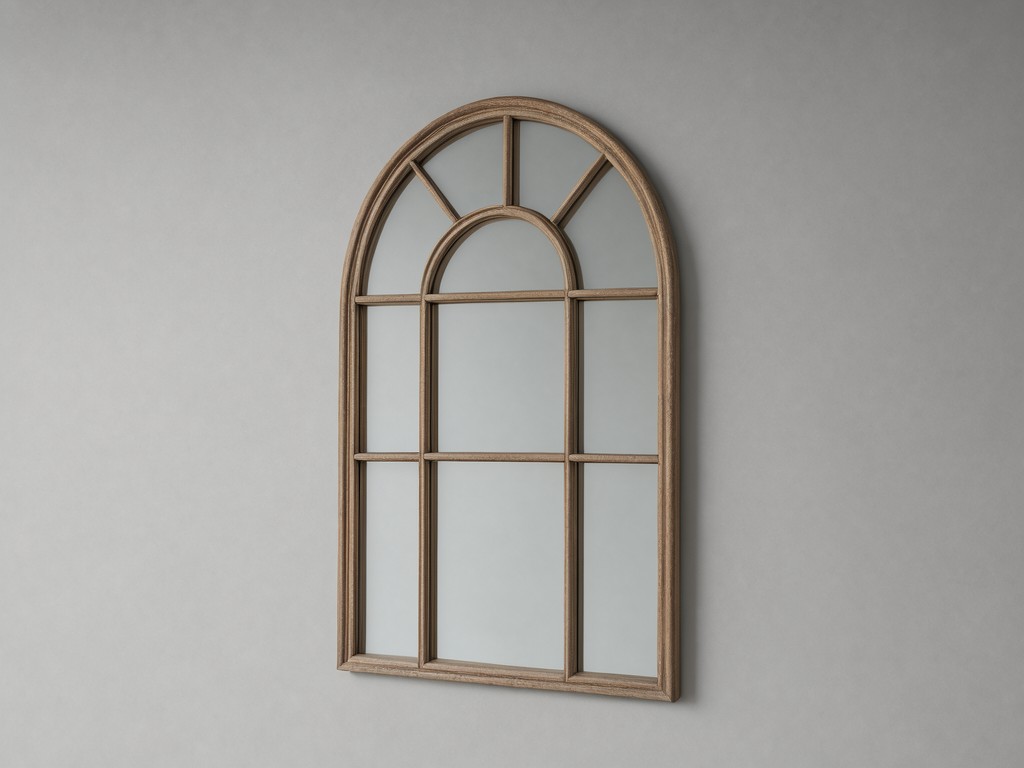
Two configurations cover most bathroom vanity programmes without new tooling. Configuration A uses 5 mm clear float glass with a 600 mm arch radius, a brushed aluminum frame and copper-free silver on MDF backing. Configuration B steps up to 6 mm low-iron glass with an 800 mm arch radius, a solid wood frame in matte black and lead-free silver with no backing board.
Configuration A — Mid-Tier Bathroom
5 mm clear float glass, 600 mm arch radius, brushed aluminum frame, copper-free silver, MDF backing, French cleat mounting, individual foam sleeve. Suitable for mid-tier bathroom programmes where freight weight matters.
Configuration B — Premium Vanity Set
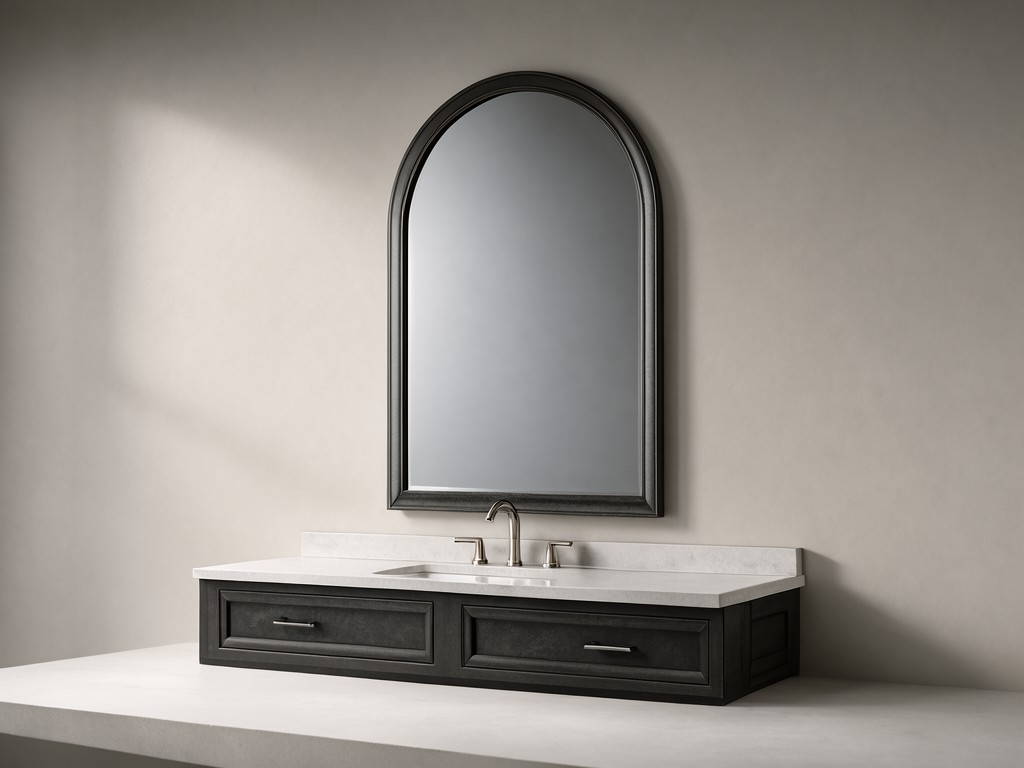
6 mm low-iron glass, 800 mm arch radius, solid wood frame, matte black finish, lead-free silver, no backing board, keyhole slots. Suitable for premium vanity sets where reflection brightness and frame presence drive the retail price.
Assumptions Buyers Should Stop Making
Returns usually trace back to the same weak point.
Buyers often assume that an arch radius quoted in a catalogue is held across the whole order. In practice, radius drift of 2–4 mm appears when the cutting tool wears or when the glass is heated unevenly during forming. The result is a mirror that does not sit flush against the wall or that leaves a visible gap next to the vanity top.
Another assumption is that bathroom humidity only affects the frame. Silver rot usually begins at the glass edge where moisture penetrates the backing, not at the frame joint. A mirror with sealed edges and copper-free silver will outlast one with exposed edges and standard silver, even when both carry the same frame finish.
Mounting hardware is also not automatic. A framed mirror may ship without wall cleats, and a frameless mirror may need adhesive rated for damp zones. Ordering the glass without confirming the fixing method means the buyer pays for a second shipment of brackets.
What Can Be Customised and What Cannot
Customisation usually covers overall width and height, arch radius, glass thickness, edge polish or bevel, frame material and finish, backing board type, mounting hardware, and carton configuration. A buyer can move from a 600 mm wide mirror to a 1 200 mm wide unit, or switch from brushed aluminum to powder-coated steel, without changing the core silvering line.
- Dimensions within the machine envelope
- Arch radius within the standard die set
- Frame finish from the existing powder-coat range
- Backing board substitution
- Packaging insert changes
What cannot be changed without new tooling or process qualification is the basic glass chemistry, the silver adhesion baseline, or the minimum order quantity tied to a radius die. A non-standard arch below the MOQ requires either a custom die charge or a compromise to the nearest standard radius. Low-iron glass and lead-free silver are available as options, but they carry a material cost premium and longer lead time.
Quality Control and Batch Consistency
The complaint that repeats across reorders is a mirror that matched the sample but not the previous shipment.
Batch consistency is controlled on radius, silver weight, edge finish and frame colour. Radius is checked with a gauge against the approved die; silver weight is verified on a sample of pieces per batch; edge finish is inspected for chips and seams under fixed lighting. Frame colour is compared to a master swatch under daylight and artificial light because metamerism makes a match look right in the factory and wrong in the showroom.
Copper-free silver costs more per square metre but delays edge blackening in humid bathrooms. Standard silver may pass a short factory inspection and fail after six weeks of shower steam. Choose the coating based on the room’s ventilation, not the unit price.
Packaging is part of quality control. A mirror that survives the factory but cracks in the LCL container is a failed batch. Corner protectors, individual sleeves and master-carton stacking limits are specified per order, and the drop orientation is marked on the outside.
Volume Planning and Lead Time
Lead time runs from sample approval to finished goods in roughly four to six weeks for standard radii and frame finishes. Non-standard arch tooling adds two to three weeks. The sample phase is the point to reject radius drift or silver tone before tooling is committed to production.
Freight configuration affects total cost more than the ex-works price. Mirrors are heavy and cube-inefficient; air freight is rarely economical for replenishment, while sea freight requires crating that survives pallet stacking. Ordering a larger annual quantity against a rolling forecast usually lowers the unit price, but it also increases the exposure if the radius tooling drifts and the whole batch must be reworked.
Sample requests are charged against the first production order. Buyers should specify the exact vanity width, wall material and humidity level so the sample represents the actual installation condition rather than a showroom mock-up. Start a sample request.
Request a Sample
Submit your vanity dimensions, arch radius and frame finish for a production sample charged against the first order.
Contact us