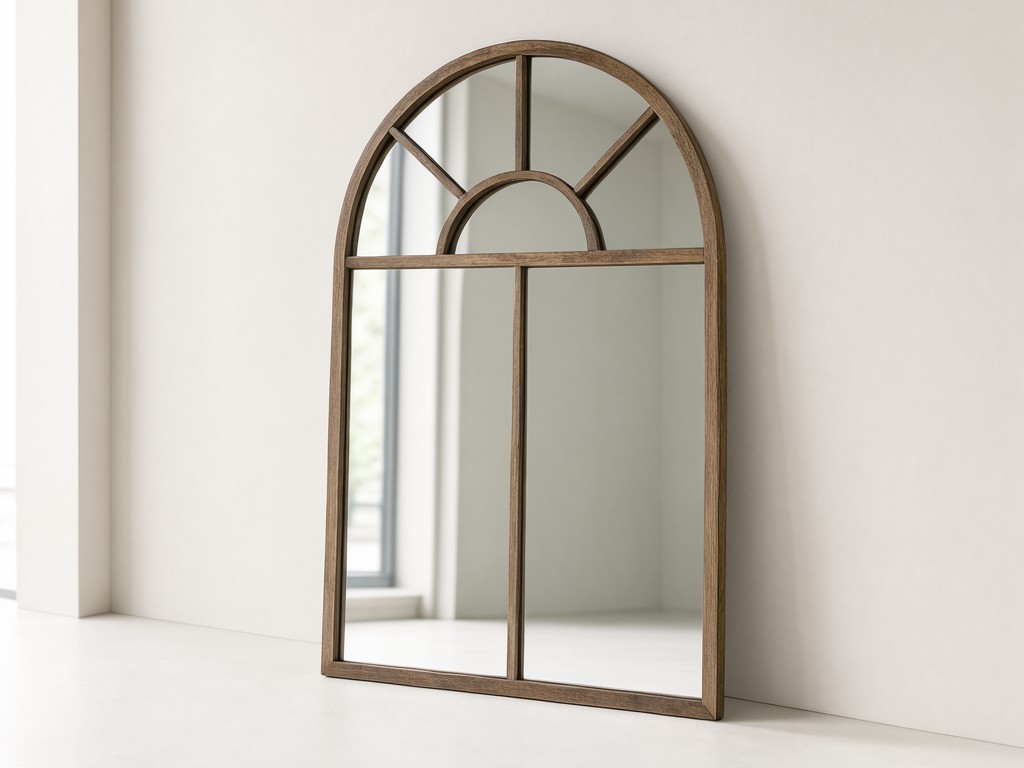
Buy vintage arched wall mirror For Sale - Bulk Supply and Specification Guide
During a private-label launch with a fixed ship date, the mirror specification usually gets locked before the first prototype ships. For an arched wall mirror, that means glass thickness, frame depth at the crown, and backing seal are fixed while the sample is still on the bench. A buyer who treats the arch as a style detail rather than a structural variable receives silvering delamination at the curve and frame joints that open after one heating season.
Batch consistency is where the unit price is decided, not the showroom floor.
Design Constraints Behind the Specification
Glass thickness controls both dead load and silvering stability. Four millimetre float glass suits dry retail walls and keeps a 600 x 900 mm arched mirror under 4 kg, which stays inside the rating of a pair of standard D-rings. Five millimetre glass adds roughly 1 kg and resists flex across the arch radius, but it forces a cleat or French cleat hanging system because the crown load outruns single-point fixings. The frame mitre at the crown must absorb seasonal expansion without opening, which rules out glued MDF corners on units over 700 mm high.
The arch itself creates a stress point where the backing board can telegraph movement into the silvering layer.
Sealed MDF backing prevents moisture from reaching the silvering edge, but it adds 300 g per square metre and changes the hanging centre of gravity.
Glass thickness
4 mm float (standard) / 5 mm float (humid zones)
Frame material
MDF with wood veneer / solid hardwood
Backing board
3 mm MDF, sealed edges
Unit weight
3.8 kg to 6.1 kg depending on glass and frame
- Silvering adhesion checked with cross-hatch tape on every tenth unit.
- Warp measured on a reference plane with a 0.1 mm feeler gauge.
- Carton drop-tested from 750 mm on all six faces.
Comparing Two Standard Configurations
Configuration A and Configuration B diverge at the backing board and the hanging hardware, not at the glass. Both use the same arched profile and the same 150 mm crown radius, so the visual match on a retail wall is identical.
Configuration A — Retail Wall
4 mm float glass, MDF frame with veneer, unsealed paper backing, two D-rings. Unit weight 3.8 kg. Best for dry, temperature-stable interiors where reorder speed matters more than moisture defence.
Configuration B — Hospitality Wall
5 mm float glass, solid wood frame, sealed MDF backing, French cleat. Unit weight 6.1 kg. Specified for corridor and bathroom-adjacent walls where condensation and cleaning chemicals attack unsealed edges.
A buyer sourcing for a humid corridor pays for the extra kilogram in freight, but avoids the warranty claim that arrives when unsealed backing swells and pushes the silvering away from the glass.
Segment-Specific Requirements
Retail showrooms and hospitality corridors punish different failure modes, so the specification has to match the service condition rather than the catalogue image.
| Segment | Wall condition | Glass spec | Frame spec | Hanging method |
|---|---|---|---|---|
| Retail showroom | Dry, stable temperature | 4 mm float | MDF, veneer | 2 x D-rings |
| Hospitality corridor | High traffic, occasional moisture | 5 mm float | Solid wood | French cleat |
| Bathroom zone | Condensation, cleaning agents | 5 mm float | Solid wood, sealed | French cleat + wall plugs |
| Contract OEM | Variable, export packaging | 4 mm or 5 mm | MDF or solid wood | Buyer-specified |
Contract OEM buyers add traceability to that list, because a repeat order that arrives with a different arch radius generates returns before the end of the season.
Quality Control and Batch Consistency
Each batch leaves the pressing line with a travel card that records glass lot, frame moisture content, and silvering batch. The factory checks crown height on a reference plane and rejects any arch that deviates more than 1 mm from the drawing. Silvering is tested with a cross-hatch tape pull on a sample from every production run, because delamination at the curve is the most common field failure.
| Parameter | Standard | Tolerance / Note |
|---|---|---|
| Glass thickness | 4 mm or 5 mm float | ±0.2 mm |
| Arch radius | 150 mm (standard arch) | ±1 mm |
| Frame depth | 20 mm MDF / 25 mm solid wood | ±0.5 mm |
| Overall size | 600 x 900 mm | ±2 mm |
| Unit weight | 3.8 kg (4 mm) / 6.1 kg (5 mm) | ±3% |
| Backing board | 3 mm MDF, sealed edges | — |
| Hanging load rating | 2 x D-rings, 15 kg each | — |
Traceability stops at the shipping label unless the buyer asks for batch codes on the carton.
Stock Availability and Reorder Planning
Minimum order quantity moves with the frame material because MDF runs on a continuous press while solid wood requires kiln-dried stock and longer lead times. A private-label buyer should hold safety stock equal to one reorder cycle to absorb glass lot changes that shift the arch radius by fractions of a millimetre.
Lead time is driven by glass tempering and backing seal cure, not by the frame itself.
Ready to review tooling for the next batch?
Request tooling review






