Best Price budget friendly arched bathroom mirror Exporter: What Buyers Should Check Before Ordering
Buyers choosing a budget arched bathroom mirror usually trade glass thickness and backing type against freight damage and callback rates. A 3 mm conventional-silver mirror cuts unit cost but shows black edge corrosion within 12 to 18 months in a humid bathroom; stepping to 4 mm copper-free backing adds roughly 15 to 25 percent to the ex-works price and typically doubles service life before backing delamination appears.
Where Cheaper Alternatives Fall Short
Consistency is set at the forming stage. A budget arched bathroom mirror is usually cut from 3 mm float glass and coated with conventional silver backing. In a bathroom, condensation sits on the unsealed edge and the silver oxidises, producing the black edge buyers see after six to twelve months of use. The arch is often ground freehand, so radius variation runs ±3 mm across a batch, and frames misfit on repeat orders.
Buyers report three failure modes: black edge creep from the perimeter, waviness in the glass that distorts reflection, and frame finish chipping at the arch corners during unpacking. Each one drives a warranty claim and blocks reorder.
Specification Range and Customisation Limits
First-article tooling determines whether a custom arch radius can be held without a new glass cutter. Standard sizes run from 600 mm by 800 mm to 900 mm by 1,200 mm with a fixed 150 mm arch radius. Glass thickness options are 3 mm, 4 mm and 5 mm; each step adds roughly 2.5 kg per square metre and changes the mounting hardware required. Backing is supplied as conventional silver or copper-free; the latter costs more but resists edge corrosion in humid rooms. Frame choices span frameless, anodized aluminium, powder-coated aluminium and MDF with foil wrap. Edge finishes include flat polish, pencil edge and bevel. Custom artwork or frame colour requires a signed drawing and approved sample before tooling is released.
| Attribute | Standard option | Custom option | Effect on price and lead time |
|---|---|---|---|
| Glass thickness | 3 mm float | 4 mm or 5 mm | Plus 8 to 18 percent unit cost; plus 3 to 5 days lead time |
| Mirror backing | Conventional silver | Copper-free | Plus 12 to 20 percent unit cost; plus 5 days lead time |
| Frame | Frameless | Anodized or powder-coated aluminium | Plus 20 to 35 percent unit cost; plus 7 days lead time |
| Edge finish | Flat polish | Pencil edge or bevel | Plus 5 to 10 percent unit cost; plus 3 days lead time |
| Arch radius | 150 mm fixed | Custom radius 100 to 300 mm | New cutter required; plus 10 to 15 days lead time |
| Mounting | Keyhole slots | Cleat system or adhesive pads | Plus 3 to 8 percent unit cost; no lead-time change |
Tolerances are typically ±1 mm on width and height and ±2 mm on arch radius unless a tighter drawing is agreed. Weight varies from 6 kg to 18 kg depending on size and thickness, which affects pallet configuration and freight class.
Comparing Two Standard Configurations
Entry export configuration
3 mm glass, conventional silver backing, frameless, flat polish edge, keyhole slot mounting, single-wall carton with foam corners.
Lowest ex-works price; higher breakage risk in LCL shipments.
Mid-range bathroom specification
4 mm glass, copper-free backing, anodized aluminium frame, pencil edge, cleat mounting, double-wall carton with corner posts.
Adds roughly 25 to 30 percent to the unit price; cuts black-edge callback rate and simplifies wall installation.
The entry configuration keeps the ex-works price lowest but arrives with higher breakage risk in LCL shipments and a shorter service life in steam-heavy bathrooms. The mid-range specification adds roughly 25 to 30 percent to the unit price, cuts the black-edge callback rate, and simplifies wall installation because the frame carries the weight instead of adhesive points alone.
OEM and ODM Programme Structure
The build method decides how fast a private-label programme reaches production. OEM orders run against an existing tool set: buyer selects from standard sizes, backing types and frame finishes, approves a pre-production sample, and production starts against the agreed tolerance sheet. ODM orders require new tooling for a custom arch radius, frame profile or backing specification. Both paths require signed artwork for any logo or frame print, a first-article inspection report, and batch traceability labels on export cartons. Lead time for OEM is usually 25 to 35 days after sample approval; ODM adds 15 to 20 days for tool making and validation.
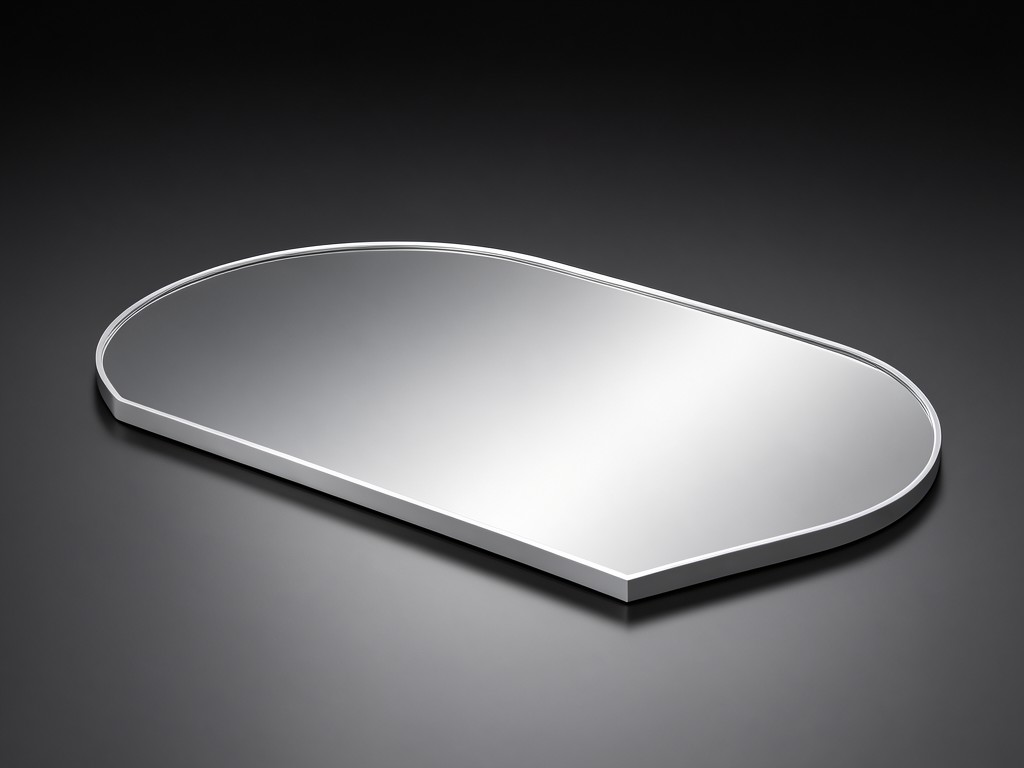
How Consistency Is Held Across Batches
A humid bathroom exposes backing adhesion and glass flatness defects that a warehouse inspection misses.
| Checkpoint | Test method | Acceptance limit | Frequency |
|---|---|---|---|
| Glass thickness | Micrometer at four points | ±0.1 mm | Every 50 pieces |
| Silver backing adhesion | Cross-hatch tape test | No coating removal | First article and each lot |
| Arch radius | Radius gauge against template | ±2 mm | Every 50 pieces |
| Frame finish | Visual inspection at 500 lux | No chips, scratches or colour variance | 10 percent sample per lot |
| Mirror distortion | Reflected straight-line test | No visible wave or warp | Every 50 pieces |
| Packaging drop | Box dropped from 1 m on corner | No glass fracture or frame damage | First article per SKU |
Results are logged by lot number and retained for 24 months. If a lot fails adhesion or thickness, the full batch is held and reworked before export packaging.
Capacity, Tooling and Scheduling
The factory runs two glass cutting lines and one backing line, with a monthly capacity of roughly 12,000 arched mirrors across standard sizes. Custom arch radii require a dedicated glass cutter and a forming template, which adds one week to the first order and is amortised over repeat volumes. MOQ is typically 200 pieces per size and finish for OEM; ODM custom tooling starts at 500 pieces. Production slots are booked against confirmed drawings, not verbal specifications.
Setup, Use and Replacement Parts
Mounting uses keyhole slots or a cleat system fixed to wall studs; adhesive-only fixing is not recommended for mirrors over 4 kg. Clean the glass with a non-abrasive cloth and avoid ammonia-based cleaners near the silver edge, since solvent contact accelerates backing delamination. Replacement parts include spare mounting brackets, frame touch-up pens and edge-sealant kits. Serviceability is designed into the frame: the mirror can be removed without breaking the glass if the cleat hardware is accessible.
Questions Buyers Ask Before Ordering
What glass thickness should I specify for a bathroom?
3 mm is acceptable for powder rooms with low humidity; 4 mm copper-free is the standard choice for main bathrooms and shower-adjacent walls.
Can the arch radius be changed without a new mould?
No. A custom radius requires a new glass cutter and forming template, so it is priced as a tooling change rather than a size option.
How do you prevent black edge on the mirror backing?
Copper-free backing plus a sealed edge treatment limits moisture ingress; conventional silver backing will show black edge within 12 to 18 months in a humid bathroom.
What is the MOQ and lead time for a private-label frame colour?
MOQ is 200 pieces per size and colour; lead time is 25 to 35 days after sample approval, or 40 to 55 days if new tooling is required.
Which packaging configuration reduces breakage in LCL shipments?
Double-wall cartons with corner posts and interleaving foam reduce breakage versus single-wall cartons with foam corners, at a modest freight-weight penalty.
Specification review
Send your mirror dimensions, backing preference and frame finish to our technical team for a quoted tolerance sheet and sample approval schedule.
Request specification review






